
DevOps is a culture and a set of practices that connect development and operations. Platform engineering is a discipline that builds an internal developer platform, a set of shared tools and “golden paths”, so that developers can build and test applications, then deploy them on their own. Platform engineering does not replace DevOps. It is one way to deliver DevOps at scale. DORA reports that by 2025, 90% of organizations used an internal developer platform and 76% had dedicated platform teams. Adopt DevOps first. Add platform engineering when many teams keep solving the same infrastructure problems.
The platform engineering vs DevOps debate mixes up culture, job titles, and team structure. This guide separates them. It draws on DORA’s platform engineering research, Google’s SRE Workbook, and AppRecode client projects.
What is DevOps?
DevOps is a loose set of practices and guidelines, plus a culture, that breaks down silos between development and operations. Google’s SRE Workbook lists five core ideas:
- No more silos between development and operations.
- Accidents are normal, so focus on fast recovery.
- Change should be gradual.
- Tooling and culture are linked.
- Measurement comes first.
DevOps says what good looks like, and it leaves the how to each organization. DevOps teams usually build CI/CD pipelines with continuous integration, automate deployment, and watch production. Our guide to DevOps best practices covers these practices in depth.
What is platform engineering?
DORA defines platform engineering as a discipline that designs and builds toolchains and workflows, often called an internal developer platform, with shared tools and services, plus golden paths. These make it easy for development teams to build and test applications, then deploy them securely and reliably, in a compliant way.
The key idea is that the platform is an internal product, and developers are its customers. It is not a pile of infrastructure tickets. The team hides underlying infrastructure so that developers do not need to become experts in Kubernetes or cloud networking, or in security policy.
DORA calls this “shifting down” cognitive load into the platform. In its 2024 research, developer independence, the ability to do tasks without waiting on an enabling team, was linked to a 5% improvement in productivity at team and individual levels.
What is the difference between platform engineering and DevOps?
The difference between DevOps and platform engineering comes down to scope and customer. The difference between platform engineering and DevOps also shows in how success is measured. DevOps is a way of working across the whole delivery process. Platform engineering is a team and a product that makes that work easier for everyone else.
| Aspect | DevOps | Platform engineering |
| What it is | Culture and practices | A discipline and an internal product |
| Main goal | Break silos, release small changes safely | Reduce developer effort through self-service |
| Customer | The business and its users | Internal development teams |
| Typical output | Pipelines, automation, monitoring | An internal developer platform with golden paths |
| How teams work | Shared ownership across teams | A dedicated platform team serving other teams |
| Key risk | Every team solves the same problems alone | The platform becomes a gate that nobody wants to use |
| How you measure it | Delivery speed and stability | Delivery metrics, developer satisfaction, and adoption |
Is platform engineering replacing DevOps, or just DevOps rebranded?
Neither. Small changes and automation, plus shared ownership, are what a good platform is built from. The team still uses CI/CD, infrastructure as code, and monitoring. Platform engineering adds a product mindset, a dedicated team, and a goal of self-service on top. Think of DevOps and platform engineering as layers, not rivals.
Platform engineer vs DevOps engineer: what is the difference?
The definition of a DevOps engineer varies by company, so treat these lists as the typical responsibilities of a DevOps engineer, not strict job descriptions. Both roles use software engineering skills, and a cloud architect often designs the underlying infrastructure they work on.
A DevOps engineer usually focuses on delivery for one product or a few:
- Builds and maintains CI/CD pipelines and release automation.
- Manages infrastructure as code and environments.
- Monitors services and responds to incidents.
- Works with developers to remove delivery bottlenecks.
A platform engineer focuses on the shared layer that many teams use:
- Designs and builds the internal developer platform.
- Creates golden paths and reusable templates.
- Treats developers as customers, and talks to them about friction.
- Measures adoption, developer satisfaction, and platform performance.
Platform engineering vs SRE vs DevOps: how do they compare?
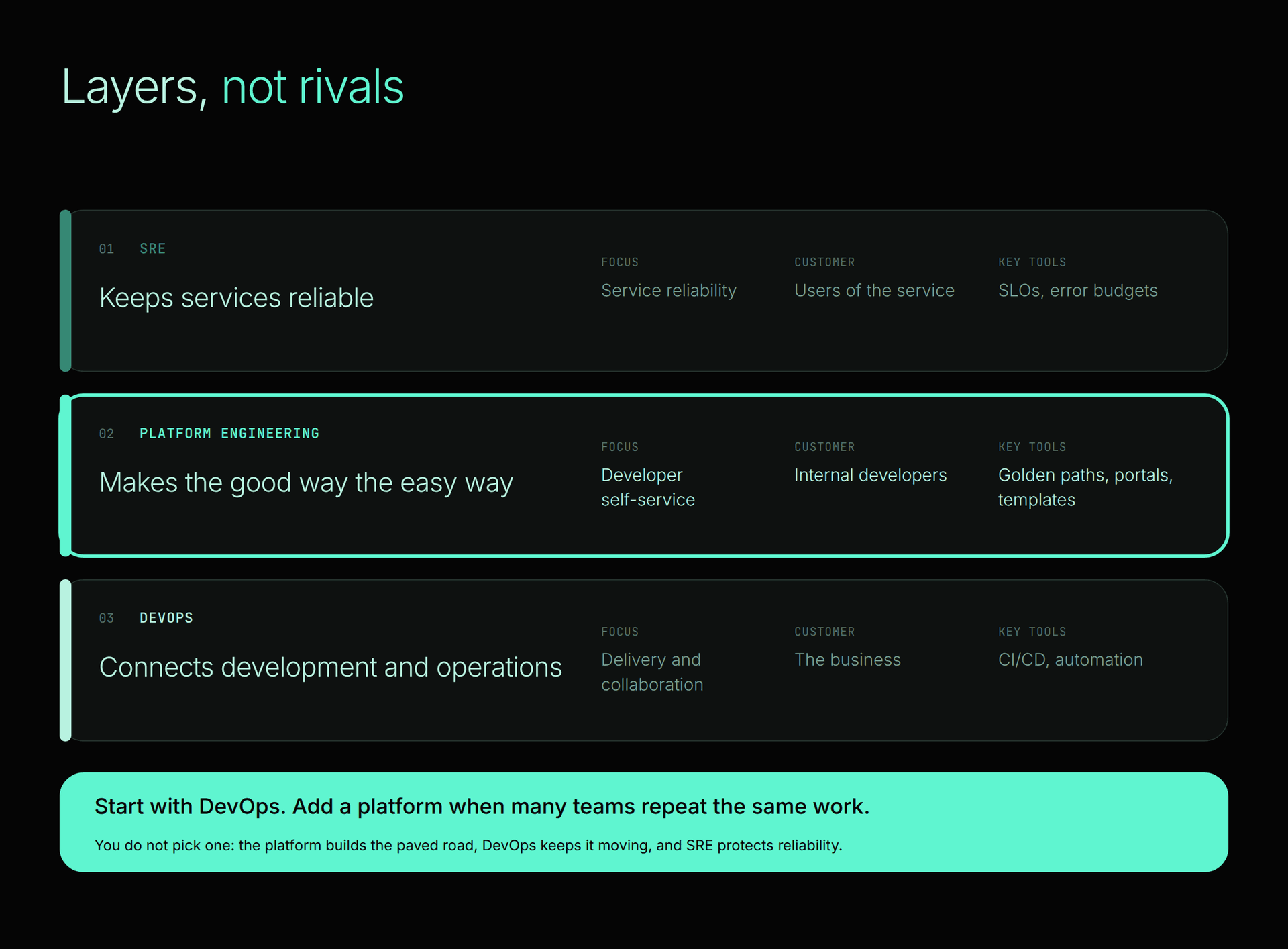
A platform engineering vs devops vs SRE comparison needs a third column. Platform engineering vs SRE is a separate question from DevOps. SRE and DevOps overlap, and SRE vs platform engineering comes down to reliability versus developer experience. SRE teams focus on reliability. Site reliability engineering is a job role and a set of practices from Google that keeps services reliable, using service level objectives and error budgets. Our guide to SRE vs DevOps covers that split.
| DevOps | SRE | Platform engineering | |
| Focus | Delivery and collaboration | Service reliability | Developer self-service |
| Customer | The business | Users of the service | Internal developers |
| Key tools | CI/CD, automation | SLOs, error budgets | Golden paths, portals, templates |
In practice, you do not pick just one. A platform team can build the paved road, DevOps keeps it moving, and SRE protects reliability.
How did DevOps evolve into platform engineering?
The evolution of DevOps is a story of scale. The principles of DevOps say that development and operations teams share one goal, and the DevOps process covers the whole software development lifecycle, from application development to software deployment. DevOps focuses on collaboration, DevOps encourages shared ownership, and DevOps promotes automation and continuous improvement. These DevOps principles still hold.
As engineering organizations grew, every development team had to configure cloud services on its own. Managing cloud resources, cloud infrastructure, and cloud environments across several cloud platforms led to duplicated work. A platform engineering approach answers that. Platform engineering teams build a management platform for self-service, and the platform engineering approach creates one common path for software development and deployment.
In short, platform engineering provides the paved road, and platform engineering creates the conditions for software delivery that is faster and safer. Software developers use it to deliver software and improve software quality across the software development life cycle. Our guide to DevOps tools lists the building blocks.
What are the main platform engineering benefits?
The platform engineering benefits that DORA research describes include:
- Less cognitive load. Developers focus on delivering user value, not on infrastructure and security detail.
- More independence. Developers can do tasks without waiting on another team, which DORA linked to a 5% productivity gain in 2024.
- A governance layer for AI. DORA’s 2025 research found that when platform quality is high, the effect of AI adoption on organizational performance is strong and positive. When it is low, the effect is negligible.
- Safer experiments. A quality platform makes failure cheap and recovery fast.
- Consistent security and compliance. Standard paths make it easier to test and secure changes, then deploy them the same way every time.
Platforms also have limits. DORA found that platforms can sometimes decrease throughput and change stability if they are not carefully managed. It also describes a “J-curve”: early gains, then a dip as complexity grows, then recovery at a higher level as the platform matures.
What are the benefits of DevOps?
DevOps benefits are broader and apply to every team:
- Faster, smaller, safer changes through automation and CI/CD.
- Fewer handoffs, because development and operations share ownership.
- Faster recovery, because accidents are treated as normal and learned from.
- Better decisions, because teams measure delivery performance.
You can get these without a platform team. A single team with a good pipeline and clear ownership already gets most of them. A platform becomes valuable when many teams need the same capabilities.
What goes wrong with platform engineering?
DORA lists five common antipatterns:
| Pitfall | What it looks like | What to do instead |
| “Build it and they will come” | A platform built on assumptions, with no user research | Interview developers and map their workflows first |
| “Ivory tower” | A central team dictates standards and acts as a gatekeeper | Work with developers, and enable them |
| “Ticket-ops” | The platform team is a vending machine for infrastructure tickets | Build self-service so tickets disappear |
| “Big bang” release | An all-in-one platform that launches after a long wait | Start with a minimum viable platform |
| “One size fits all” | A rigid golden cage that fits no team well | Offer enabling constraints and room for different needs |
DevOps vs platform engineering: when should you adopt each?
Use your biggest pain as the guide. These are our recommendations, based on the DORA material above.
| Your situation | Lean on | Why |
| Slow, manual releases and silos between teams | DevOps | You need pipelines and automation, plus shared ownership first |
| Many teams rebuild the same pipelines and environments | Platform engineering | A shared platform removes repeated work |
| Developers wait days for infrastructure from a central team | Platform engineering | Self-service shortens the wait |
| One product and a small team | DevOps | A dedicated team costs more than it saves |
| You are rolling out AI coding tools widely | Both, with a strong platform | Platform quality decides whether AI gains reach production |
| Security reviews and compliance slow every release | Platform engineering | Build checks into the golden path |
A common order is to start with DevOps, then add a platform when the pain is repeated across teams. Our guides to scaling DevOps in large organizations and a DevOps center of excellence cover team structure.
How do you start with platform engineering?
DORA’s guidance gives a clear path:
- Treat the platform as a product. Assign a product manager, and build a roadmap from developer needs.
- Map critical workflows. Examples are “spinning up a new service” and “debugging a production issue”. Find where developers lose the most time, and optimize that step first.
- Build a minimum viable platform. Choose the golden path for your most common workflow, and make that one workflow demonstrably better.
- Design for extensibility. Let other teams contribute tools through clear APIs, so the platform team does not become a bottleneck.
- Give clear feedback. In DORA’s 2025 data, the platform capability most linked to a good user experience was clear feedback on the outcome of tasks.
- Expect the J-curve. Plan for the dip so leaders do not cancel the program.
How do you measure platform engineering and DevOps?
DORA recommends a balanced scorecard:
- Delivery performance: change lead time, deployment frequency, failed deployment recovery time, change fail rate, and deployment rework rate. See our DevOps metrics guide.
- Developer satisfaction: regular surveys such as CSAT or Net Promoter Score.
- Adoption and retention: how fast new teams join the platform, and whether they keep using it.
- Task success: how well developers complete key workflows.
How can AppRecode help?
AppRecode’s DevOps consulting company service covers strategy, CI/CD design, and monitoring, and it works with existing infrastructure and tools. Our Kubernetes consulting and CI/CD consulting teams build the pipelines and platform layers. Not sure whether you need a platform team yet? A DevOps health check shows where your delivery pain sits.
“Our decision to work with AppRecode was based on their understanding of our industry, the depth of their technical capabilities, and a real commitment to building a true partnership model.” Dr Liam Terblanche, Founding member of Scriversi
To scope your own program, send a request.
FAQ
Is DevOps replaced by AI?
No. DORA’s 2025 research calls AI an amplifier of an organization’s strengths and its dysfunctions. Individual coding gains are often lost to downstream bottlenecks in testing, security reviews, and deployment. A high-quality internal platform is how those gains turn into team results.
What are DevOps platforms?
A DevOps platform bundles tools for the delivery process, such as source control, CI/CD, and security scanning, in one place. An internal developer platform is related but different: it is built by your own platform team around your developers’ workflows. See our guide to DevOps tools for the tool categories.
Can platform engineering and DevOps work together?
Yes, and they should. DevOps supplies the practices, and the platform makes them easy for every team to follow.