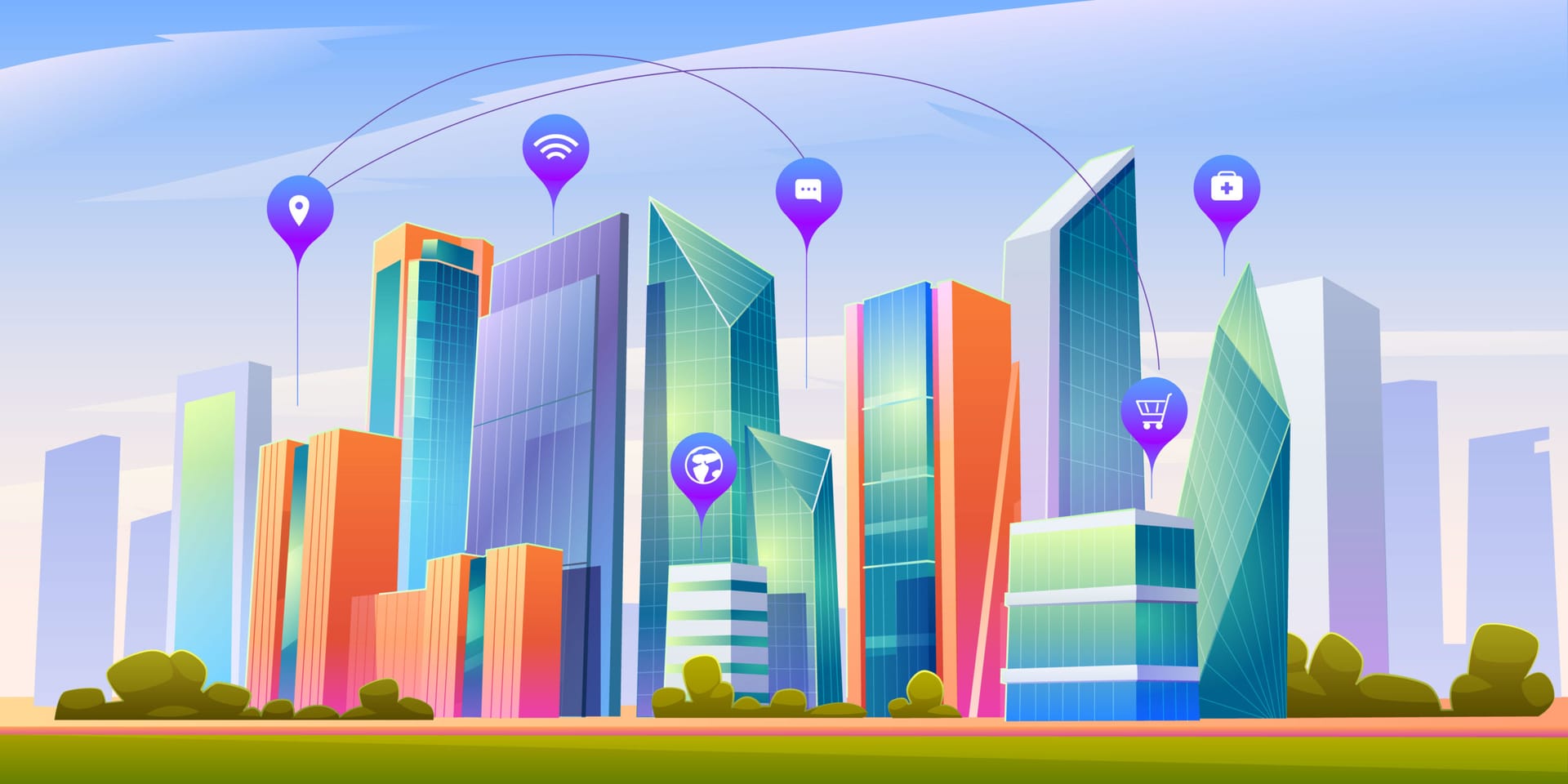

IoT technologies for smart cities can unlock entirely new approaches to urban planning and living. What has once been a utopia is now a reality – the Internet of Things is widely applied in the urban setting.
In our new article, we explore the notion of IoT in smart cities. We also provide an overview of points to consider while working on a smart city project using IoT.
What Is IoT for Smart Cities?
The combination of IoT and smart cities is aimed at improving the way urban environments function. In fact, IoT applications in smart cities can:
- Measure traffic patterns
- Assess energy consumption
- Track air quality
- Analyze water usage
- Monitor waste levels
- Identify public safety signals
And these are not the only implementations for such technologies. The ultimate goal behind the idea of a smart city with IoT is weaponizing data.
Better data → better decisions → better city life
Key Benefits of IoT in Smart Cities
The combination of the Internet of Things and smart cities can bring urban communities the following benefits.
1. Smarter use of city resources
When everything from water pipes to streetlights can “talk,” cities stop guessing and start acting. Smart meters spot leaks early, grids adjust themselves, and entire districts stop wasting energy just because someone forgot to flip a switch.
2. Safer streets and quicker responses
The network of cameras, sensors, and alarms can play a crucial role in crime prevention. On the one hand, once any issue occurs, an emergency team or the police receives an automated alert. Secondly, the understanding of the fact that there is always something watching can prevent criminals from committing possible acts of misconduct.
3. Traffic that doesn’t feel like punishment
Real-time traffic signals, intelligent parking systems, and IoT-backed public transport finally give cities a way to untangle their own roads. Drivers get nudged toward open parking, buses stay on schedule more often, and planners get actual data instead of “gut feeling.”
4. Air quality control
It is one of the most common applications of IoT in smart cities. With such solutions, authorities can monitor pollution levels and notify citizens about related threats.
5. Comfortable everyday life
IoT smooths out dozens of micro-annoyances. In fact, it:
- Monitor transport schedules
- Notifies citizens about traffic jams
- Automate document management across city offices.
Top IoT Applications in Smart Cities
These are the most popular examples of IoT usage in smart cities:
- Many urban areas involve smart transportation systems with GPS-enabled public transport, traffic jam detection, and smart management of traffic lights.
- IoT-powered energy grids help urban areas optimize electricity loads.
- Cities lean on all sorts of connected tools now—cameras that spot trouble early, fire sensors that shout before anyone smells smoke, even buttons people can hit when things go sideways.
- Trash is smarter too. Routes shift on the fly, recycling gets sorted better, and data hints when a bin will overflow before it actually does.
- And for the environment, tiny sensors watch the air, water, weather, and noise so the city always has a snapshot of what’s really going on outside.
Real-World Examples of Smart City Projects Using IoT
A few cities are already deep into the IoT experiment.
Barcelona
Barcelona, for example, has sensors practically everywhere—parking spots, streetlights, watering systems, even the power grid—quietly keeping the city running smoother than it probably looks on paper.
Singapore
Singapore takes an even bigger swing with its “smart nation” idea, using connected tech for everything from traffic flow to waste pickup and public safety alerts.

Chicago
While cruising across Chicago, you can find a great number of sensor boxes. These are designed to help local authorities monitor air quality and noise levels.

“Weaponizing data is the best way for city authorities who want to improve the quality of living in their areas. The Internet of Things for smart cities becomes a transformative force that allows the authorities to collect various data that helps them come up with tailored policies.”
Volodymyr Shynkar, Founder at AppRecode
IoT Technologies Driving Smart City Development
Behind every network, there are crucial technologies. These are the main technology solutions that power IoT systems for smart cities.
Sensors and edge devices
To collect real-time data, city authorities apply:
- Environmental sensors
- Traffic counters
- Cameras
- Meters
- Building monitors
Connectivity technologies
The most common types of networks applied for connecting devices and sensors in smart cities are:
- LoRaWan
- 5G
- NB-IoT / LTE-M
- Wi-Fi
- Ethernet
Cloud services
To host the software part of IoT systems and to connect it with devices, companies use solutions from the major cloud providers. These include:
- AWS IoT
- Azure IoT Hub
- Google IoT Core
Data analytics and AI
Analytical tools combined with IoT can provide insights on:
- Power usage
- Traffic patterns
- Climate conditions
Challenges of Implementing IoT in Smart Cities
Surely, there are always challenges associated with data exchange across IoT networks:
- Data privacy and security risks
- Device interoperability issues
- High initial costs
- Concerns regarding system scalability
- An abundance of privacy laws and regulations that should be considered
How to Build a Smart City Project Using IoT
To avoid all the challenges mentioned above, it is important to take a responsible step-by-step approach to IoT implementation in urban settings.
- First, define the problem faced by your city. Whether you need to optimize traffic or improve air quality, problem definition proves to be crucial.
- Try to start with a localized, small-scale implementation. At least, this will help you make necessary estimates and assess whether your idea is valid.
- Consider your goals and the city’s specifics to make the right technology choices.
- Make sure that devices and networks work well together.
- Ensure fortified security and efficient data governance.
- Plan for long-term project implementation and project scalability.

Let’s Build a Smarter, More Connected City Together
We help cities and enterprises turn IoT concepts into working ecosystems — from architecture design to integration and long-term support.
Start HereWhy Choose AppRecode for Smart City IoT Projects
Handling complex smart city IoT projects might be extremely challenging. There are just too many things to consider. One way to complete such a project is to rely on a team with strong IoT in DevOps experience.
AppRecode can provide such a team. We have solid expertise in developing IoT solutions and apply the best DevOps practices to ensure continuous growth and upgrades for your system. Check out our Clutch profile to know more about our projects. Contact us to build a revolutionary IoT for smart city.
Final Thoughts
The Internet of Things changes the entire doctrine of urban planning. With the growing usage of IoT solutions, authorities have unprecedented possibilities for improving the quality of life in the cities.
The ultimate goal is to overcome the main challenges with the help of experts in designing smart cities with IoT.
FAQ
How is IoT used in smart cities?
In a smart city, IoT is basically the city getting live notes from its own streets and equipment. A lamp can say it is broken. A water meter can show strange pressure at night. A bus can report where it really is, not where the timetable hoped it would be. That is the useful part.
I would not describe it as sprinkling sensors everywhere. That gets expensive and creepy fast. The better approach is to pick a service problem and ask what field data would help people fix it sooner.
For traffic, that might be vehicle counts and signal timing. For waste, it might be bin levels. For air quality, it might be pollution readings by block. For utilities, it might be leaks, outages, or unusual use.
The system still needs humans and processes. Someone has to receive the alert, trust the data, and act. Without that loop, smart-city IoT becomes another dashboard nobody opens.
What are the main benefits of IoT for cities?
The best benefit is not “more technology.” It is less guessing. City teams make decisions every day about roads, lights, water, waste, transport, and emergencies. IoT can give them fresher information than a complaint form, a manual inspection route, or last year’s planning report.
Some examples are simple. Smart lighting can save energy. Leak sensors can reduce water loss. Waste-bin sensors can stop trucks from visiting half-empty bins. Air sensors can show which neighborhoods need attention. Traffic data can help tune signals or warn residents before a route turns ugly.
But I would be careful with promises. Sensors do not fix a broken maintenance process. A city still needs budgets, crews, procurement, cybersecurity, and public trust. If nobody acts on the data, the benefit is mostly marketing.
The best smart-city projects connect one signal to one action: detect, decide, respond, and measure whether the service improved. That is where the value is.
What technologies are needed for a smart city IoT system?
If I were scoping a smart-city IoT project, I would not start with the cloud slide. I would start at the pole, road, pipe, bus, or building where the thing has to work in rain, heat, dust, and bad maintenance days.
There is a device first: maybe a meter, camera, air sensor, parking sensor, flood sensor, or streetlight controller. Then it needs a network. A tiny battery sensor can use LoRaWAN or NB-IoT. A camera probably cannot. Buses and service vehicles may need cellular. Some busy sites still need fiber or Wi-Fi.
Then the data needs a home. Fast local reactions may happen at the edge. Slower analysis can go to a cloud or city platform for dashboards, alerts, reports, and work orders.
The boring pieces decide whether it survives: device identity, updates, spare parts, monitoring, owners, and a plan for bad readings. Without that, the architecture is just a nice diagram.
What are the biggest risks of IoT in smart cities?
The biggest risks are not hard to imagine, because smart-city IoT lives in public space. A bad decision can affect residents, workers, traffic, utilities, or trust in city government.
Privacy is the first risk I would raise. A parking project may sound harmless, but location patterns can become sensitive when mixed with other data. Cameras, phone signals, license plates, and movement data need extra care. Collect less, keep it for less time, and explain the reason clearly.
Security is the next problem. City devices can be outside for years, exposed to weather, tampering, weak passwords, missed patches, and vendor neglect. One forgotten gateway can become an entry point.
Bad data is quieter but still serious. A faulty sensor can send confident nonsense, and an automated system may act on it.
Finally, lock-in matters. If only one vendor can read the data or replace the devices, the city may be trapped long after the pilot looked successful.
Which smart city IoT projects should a city start with?
For a first project, I would choose something painfully ordinary. Broken streetlights. Water leaks. Waste trucks visiting bins that are not full. Parking searches around a hospital. Air quality near a school. These are not glamorous, but they are easy to explain to residents and city staff.
The project should have a clear before-and-after measure. Did repair time drop? Did truck mileage fall? Did drivers spend less time circling? Did the city catch leaks earlier? If nobody can name the metric, the pilot is probably too fuzzy.
Ownership matters more than people expect. A sensor can report a problem, but it cannot send a crew, approve a route change, or update a resident. Someone inside the city has to own that loop.
I would avoid starting with a huge all-purpose platform. Start narrow, prove value, learn the maintenance burden, then expand. A small boring win is better than a smart-city showcase that dies after the press release.
How should cities protect privacy in smart city IoT projects?
For privacy, I would begin by throwing data away on purpose. If a traffic team only needs a count, collect a count. If a lighting system only needs to know that somebody moved nearby, do not keep video of the person. The cleanest personal data is the data you never stored.
This is where smart-city projects can go wrong. A harmless sensor can become sensitive when it is combined with time, place, cameras, phone signals, or license plates. So the city should use aggregation, short retention, masking, and delayed data whenever that still solves the job.
The rules need to be written before launch. Who can open the data? Who approves sharing? What can the vendor reuse? When is it deleted? What happens if another department wants a new purpose later?
Residents should not have to guess. Put the answer in plain language: what is collected, why, and for how long. A city can buy sensors quickly, but trust takes longer to earn.
How can smart cities avoid vendor lock-in?
Lock-in usually does not look dangerous during the pilot. The demo works, the dashboard is pretty, and the vendor is helpful. The trouble starts later, when the city wants another vendor, a new dashboard, or five years of historical data in a normal format.
I would ask the dull questions before the contract is signed. Who owns the data? Can the city export it without paying a penalty? Are the APIs documented? Can other systems read the data? Can the devices work with another gateway or platform? What support is promised if the city leaves?
Open standards are useful, but they need proof. A vendor saying “open ecosystem” is not enough. Ask for a sample export, API documentation, and a realistic exit plan.
The safest buying pattern is small at first. Prove the service, security model, maintenance work, and portability before city-wide rollout. Changing vendors should be annoying, not catastrophic.