
TL;DR
- A clear MLOps roadmap exists because notebooks do not cover releases, drift, or ownership.
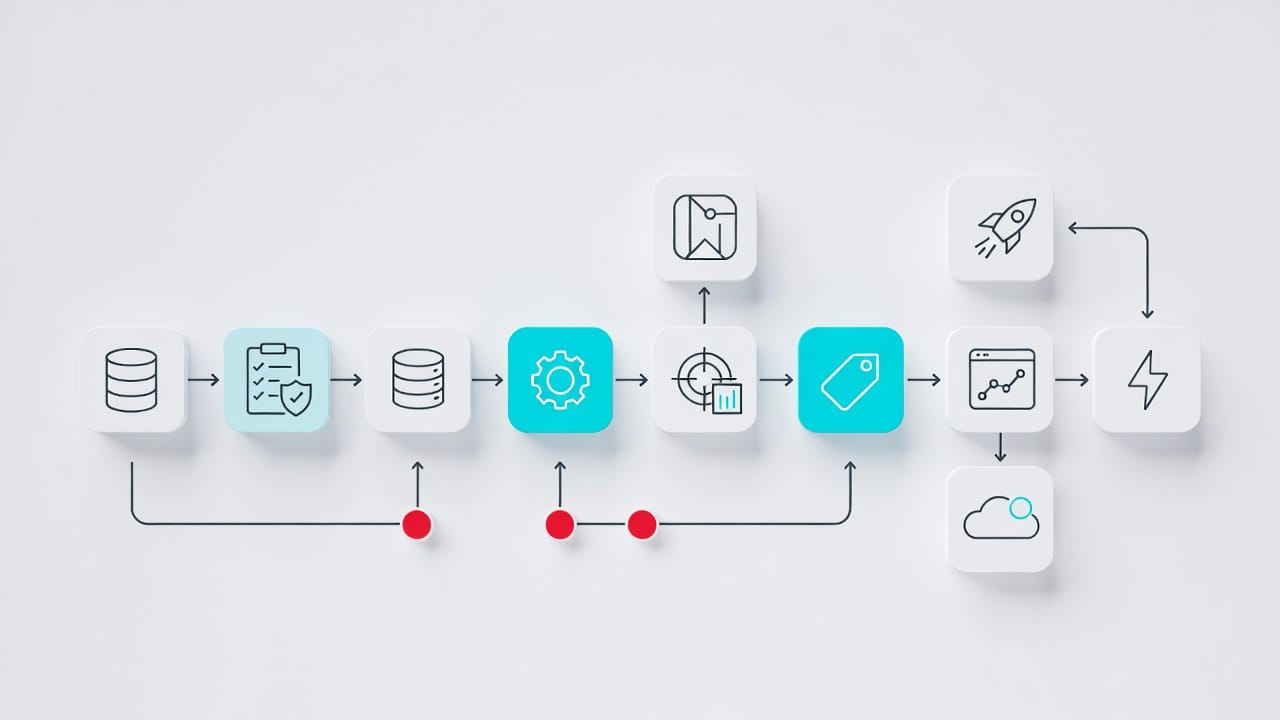
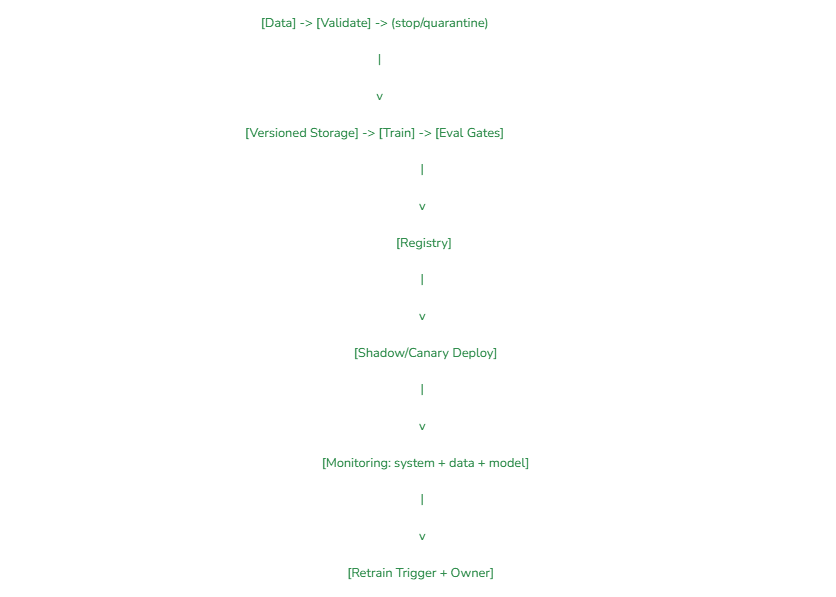
- The MLOps Roadmap diagram showing the full loop and gates.
- Get reproducibility right, add the tools you need to interface with others (and automate), and only then let the automation come.
- As for new tools, just plunge in, the often best way to learn is figuring things out yourself.
- Use monitoring for system, data, and model signals, or the drift stays invisible.
- A good MLOps plan, moving from DevOps starts with testing and monitoring automatically, adding data and model checks.
- Use a maturity path: MVP → controlled releases → monitoring → continuous training.
MLOps exists because ML work often breaks at the production boundary. The model looks fine in a notebook, but no one can reproduce the run, deploy it safely, or detect drift before business metrics drop.
This guide gives a step-by-step learning path, a skill map, projects, and one copyable MLOps roadmap diagram. It is a practical MLOps learning roadmap for beginners, ML engineers, and DevOps engineers. If you want a second set of eyes on your setup, start with MLOps consulting.
Why MLOps Exists (ML → Production Gap)
Teams hit three common failures:
- Results are not reproducible because data, code, and dependencies drift.
- Changes break silently because there are no gates or rollout rules.
- Drift goes unnoticed because monitoring stops at uptime.
For a platform view, see MLOps architecture.
What MLOps Covers
The MLOps Lifecycle in One Picture
Think of MLOps as one loop:
data → train → validate → register → deploy → monitor → retrain.
A good roadmap for MLOps also includes who can use the system, ensuring the right permissions, keeping records of what happens, and handling problems when they arise.
MLOps vs DevOps vs Data Engineering
DevOps ships software reliably. Data engineering ships data reliably. MLOps ships models reliably, while handling drift and evaluation gates.
If you want a more detailed comparison, check out AIOps vs MLOps and DataOps vs MLOps.
MLOps Roadmap for Beginners (Step-by-Step)
Use this roadmap for beginners to achieve the foundations of MLOps, learn a concept and build it step by step. There should be no skipping on reproducibility because the automation later will end up being messy.
Stage 0. Prerequisites (1–2 Weeks)
Focus: Start with learning Python basics, how to use Git, basic Linux commands, how Docker works, and how to test your code.
Project: containerize a small inference API, and run tests in CI. If your foundations need a quick audit, use a DevOps health check.
Stage 1. ML Fundamentals (2–4 Weeks)
Focus: baselines, leakage, evaluation, and metrics by segment.
Project: build a baseline churn model, write a short model card, and explain failure cases. This is the start of a real MLOps engineer roadmap.
Stage 2. Data Foundations (2–4 Weeks)
Focus: versioned datasets, schema checks, label health, and freshness.
Project: build ingestion plus validation, with a quarantine path for bad data. This is where many teams first feel why an MLOps skills roadmap needs data skills.
Stage 3. Packaging and Reproducibility (2–3 Weeks)
Focus: pinned dependencies, config files, artifacts, and repeatable runs.
Project: run training from a clean environment, produce an artifact, and store metrics plus data references. Your MLOps learning roadmap should treat reproducibility as a gate, not a bonus.
Stage 4. MLOps Core Tooling (4–6 Weeks)
Focus: orchestration, experiment tracking, and a model registry workflow.
Project: add a registry step with “staging” and “production” versions, and a promotion rule. For tooling choices, use the MLOps tools list.
Stage 5. Deployment (3–5 Weeks)
Focus: stable prediction contracts, batch vs online serving, and safe rollouts.
Project: deploy with shadow or canary, define rollback triggers, and measure impact. This stage sharpens your MLOps engineer roadmap because you now own outcomes, not notebooks.
Stage 6. Monitoring and Reliability (3–5 Weeks)
Focus: three layers of monitoring:
- System: latency, errors, saturation
- Data: schema shifts, distribution drift
- Model: quality proxies, segment health
Project: connect alerts to owners and runbooks. Use real use cases as a reference: MLOps use cases.
Stage 7. CI/CD/CT (Continuous Training) (3–6 Weeks)
Focus: release gates, automated validation, and retraining triggers.
Project:
retrain → validate → register → deploy → monitor, with stop points and rollback.
If you want help joining classic CI with ML gates, consider CI/CD consulting.

Want a working foundation faster?
AppRecode can set up tracking, a registry, and CI gates through MLOps development. Start with MLOps consulting if you need a gap list.
Start HereMLOps Roadmap Diagram
Copy this diagram into docs, then adapt owners and gates.
Illustration task: convert the diagram into a simple vector graphic, show the gates as red “stop” nodes, and show the loop back to training.
MLOps Skills Roadmap
A practical skills map is a stack, not a checklist:
- Engineering: Git, packaging, Docker, tests.
- Data: schemas, snapshots, validation, labels.
- ML: evaluation, baselines, bias, and segments.
- Platform: orchestration, tracking, registry.
- Release: rollout, rollback, approvals.
- Ops: monitoring, runbooks, postmortems.
Look at this map again after each project and add anything you noticed was missing when you shipped the items.
DevOps to MLOps Roadmap
A fast transition from DevOps to MLOps keeps what DevOps already does well (CI/CD, IaC, observability), then adds ML-specific controls:
- Data and model validation gates
- Registry promotion rules
- Drift monitoring and retraining triggers
For production patterns, review MLOps best practices. This approach works best when you ship one model end to end, then generalize.
Projects That Make This Roadmap Real
Use these as portfolio projects for your roadmap for MLOps:
Keep each project small, publish it, and write a one-page runbook so reviewers see operational thinking clearly, too.
- Reproducible training repo (one command run, logged inputs and outputs)
- Registry promotion workflow (staging → production, plus change log)
- Serving contract project (API spec, load test, fallback behavior)
- Monitoring pack (dashboards, alerts, runbooks)
- Continuous training loop (trigger, gates, canary, rollback)
Community references:
Keep in mind, employers and clients care more about working deployments with monitoring than perfect accuracy in notebooks.
Tooling Map
Map tools to functions, not to hype. Your plan should cover:
- Validation (data and model)
- Orchestration (scheduled and triggered runs)
- Tracking (metadata and lineage)
- Registry (versions and promotion)
- Serving (batch and online)
- Monitoring (system, data, model)
- Release automation (CI/CD/CT)
If you need help building the platform itself, AppRecode provides MLOps development.
How AppRecode Helps Turn a Roadmap Into a Working MLOps Platform
AppRecode helps teams move from a learning plan to a working system by defining architecture, gates, ownership, and an implementation sequence. Many teams start with MLOps consulting, then extend into delivery once the gaps are clear.
See reviews on Clutch.
“Teams rarely fail because they lack ML talent. Teams fail because nobody owns the gates, the data contracts, and the rollback plan. A simple roadmap with stop points beats another tool.” – Volodymyr Shynkar, CEO of AppRecode.
Want to turn your MLOps roadmap into a platform with gates and owners?
Start with MLOps consulting or scoped MLOps development.
Start HereFinal Thoughts
A strong MLOps engineer roadmap is a loop with checks, releases, and feedback, not a pile of tools. If you ship one project per stage, you will learn faster, and you will avoid “mystery drift” incidents later.
FAQ
What is the best MLOPs roadmap for beginners?
The best MLOPs roadmap for beginners starts with reproducibility, then adds a registry, controlled deployment, and monitoring before continuous training. A beginner roadmap works when every stage includes a real project and clear gates.
How Long Does It Take to Become an MLOps Engineer?
Everyone’s pace is different, but we’d estimate 3 to 6 months of all-out effort for someone just starting from scratch and with enough decent data for the tasks. MLOps learning roadmap consists of milestones for each week, and this should be enough to keep you on track and avoid getting sidetracked and wasting time.
What Skills Matter Most in an MLOps Skills Roadmap?
The core is versioned inputs, reproducible training, release gates, and monitoring tied to owners. Those skills prevent silent failure and reduce firefighting.
What Is the Fastest DevOps to MLOps Roadmap?
The fastest path starts from CI/CD and observability, then adds data and model gates plus registry promotion rules. That path keeps DevOps strengths, while adding MLOps-specific controls.
What Should an MLOps Roadmap Diagram Include?
A useful diagram includes the end-to-end loop, gates, owners, alerts, and retraining triggers. The diagram should also show at least one safe rollout method and one rollback rule.