
TL;DR
- DataOps vs MLOps is not a turf war. It is usually a sequencing problem.
- Start with DataOps when data quality, lineage, and pipeline reliability fail more often than models.
- Start with MLOps when models ship slowly, behave oddly in production, or need safe retraining.
- Teams require both elements because their main operational challenge emerges from the process of converting data into models.
- Your bottleneck requires KPIs which need to monitor three essential performance indicators that include time-to-data and data incidents and drift alerts and rollback rate and retrain cadence.
- If you can’t reproduce a dataset or a model version, you don’t have “ops.” You have hope.
Teams mix up the terms because both borrow habits from DevOps: version control, tests, automation, and shared ownership. Often, only a good partner at your side is the remedy you need. IBM and Coursera frame them as workflow disciplines for data pipelines and ML lifecycles, not just toolsets.
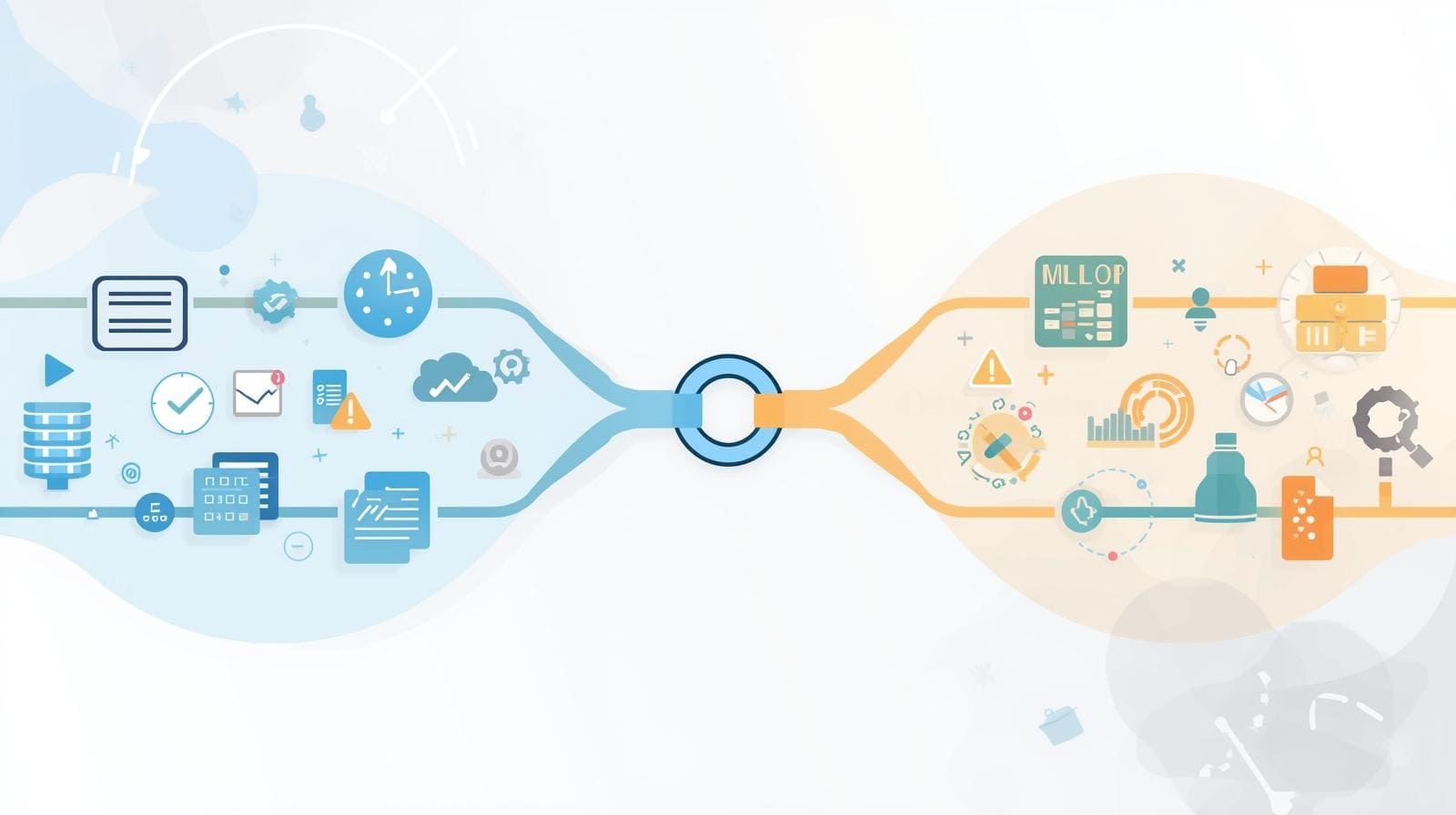
The choice between MLOps and DataOps often comes down to the order of operations. If your data pipelines lie, your models will lie with confidence. If your models ship without monitoring, they will fail quietly until users yell. That’s why choosing between DataOps and MLOps rarely means “either-or.”
This article covers quick definitions, a comparison table, a decision tree, KPI metrics, and the overlap failures most teams hit when comparing DataOps vs MLOps in real delivery work.
What is DataOps?
DataOps serves as a collection of practices which enable organizations to develop and test and deploy and monitor their data pipelines for delivering reliable data with consistent quality and defined precision. The problem appears in all systems which use analytics and BI and reporting and feature pipelines and data transfer between different systems.
Core goal: the system provides users with fast access to reliable data which helps stop pipeline accidents while it establishes unambiguous responsibility.
What DataOps is NOT
- Not “just ETL.” ETL is a step; DataOps includes testing, lineage, change control, and monitoring.
- Not “only tools.” Tools help, but the real work is standards, reviews, and operational habits.
This is where machine learning operations and data operations start to overlap: models can’t stay stable if data delivery stays unstable.
What is MLOps?
MLOps uses engineering and operations methods to manage the entire ML development process which includes experiments and training and validation and deployment and monitoring and retraining. The system operates to achieve safety and production reliability after the model begins its manufacturing process.
Core goal: ship models to production faster, keep them correct, and keep them observable.
What MLOps is NOT
- Not “only deploy the model.” Production work includes feature consistency, drift detection, model governance, and safe rollbacks.
- Not “a platform you buy.” A platform helps, but you still need clear gates and ownership.
When people argue MLOps vs DataOps, they often ignore that MLOps depends on stable data inputs and clear data contracts.
Comparing DataOps vs MLOps: what’s different
Here is a practical view of the data operations and machine learning operations and data that tends to matter during incidents and planning.
| Area | DataOps | MLOps |
|---|---|---|
| Object of control | Data pipelines, datasets, tables, SLAs | Models, features, training runs, inference services |
| Failure modes | Late data, broken schemas, silent nulls, wrong joins | Drift, bias, training-serving skew, bad rollouts, stale models |
| Team ownership | Data engineering, analytics engineering, platform | ML engineering, data science, platform, app owners |
This is the heart of DataOps vs MLOps: DataOps controls how data changes; MLOps determines how model performance will transform when the input data or programming code or operational environment undergoes any modifications.
Differences between DataOps and MLOps: lifecycle view
A lifecycle view makes the differences between DataOps and MLOps hard to miss.
Data lifecycle: ingest → transform → test → publish → monitor
ML lifecycle: experiment → train → validate → deploy → monitor → retrain
If you run both, you are managing data operations and machine learning operations and data as one system: upstream data decisions show up downstream as model incidents. (Yes, that phrase is awkward. So are most production incidents.)
Similarities between MLOps and DataOps
The similarities between MLOps and DataOps are real, and they matter:
- Versioning and reproducibility (data snapshots, model artifacts)
- CI checks and automated tests (data tests, model tests)
- Observability and incident response (alerts, runbooks, on-call)
- Security and governance (access control, audit trails, approvals)
- Cross-team collaboration (data, ML, platform, and app teams)
IBM highlights shared themes like automation and cross-functional collaboration across both practices.
For peer perspectives and real-world experiences from practitioners, you can explore this community discussion on DataOps vs MLOps frameworks.
This is why teams should talk about DataOps along with MLOps, not as rival badges.
Choosing between DataOps and MLOps: a simple decision tree
Use this when the choice between MLOps and DataOps blocks planning.
Start with DataOps if…
- You don’t trust your data (missing values, silent schema changes, “numbers don’t match”).
- Pipelines break weekly, and nobody owns fixes end-to-end.
- You can’t reproduce the dataset used for last month’s metrics.
- Your biggest pain is delivery of “clean enough” data, not model behavior.
Start with MLOps if…
- You can train models, but production releases take weeks.
- You lack model monitoring, drift alerts, or rollback paths.
- You see training-serving skew, or features differ between the batch and online settings.
- You need frequent retraining, but do it manually.
You need both if…
- Multiple teams consume the same features and datasets.
- You run multiple models across multiple services with frequent changes.
- Regulators, audits, or internal risk reviews require traceability.
This decision tree usually ends at “both,” which is why MLOPs and DataOps often converge into a single platform roadmap. For build-and-run help, AppRecode’s DevOps solutions can cover shared foundations like CI, observability, and release gates.
(Second mention) If someone demands a single answer to choosing between DataOps and MLOps, ask what breaks more often: data delivery or model behavior. That answer usually decides sequence.
The overlap: where most teams fail
Most failures happen in the seam between machine learning operations and data operations:
- No clear data contracts: a column changes type, and inference breaks.
- No feature parity: offline training uses one transformation, online serving uses another.
- “Works in notebook” syndrome: no reproducible pipeline for training data.
- Ownership gaps: the data team blames the model team, the model team blames the data team, and the outage keeps running.
A community thread provided a helpful test which showed that DataOps functions as DevOps-based data engineering practices yet MLOps requires additional monitoring and model behavior management. That community framing helps when comparing DataOps vs MLOps in a meeting that’s going nowhere.
Metrics that prove progress
Pick a few KPIs, and review them monthly. Otherwise, you will “feel” progress right up until the next incident.
DataOps KPIs
- Time-to-data: time from source change to trusted data published
- Pipeline failure rate: failed runs per week, plus mean time to recovery
- Data quality incident rate: null spikes, schema breaks, duplicate keys
- Freshness SLA adherence: % of tables delivered on time
- Change lead time: time from PR to production for pipeline changes
- Cost per pipeline run: especially for heavy transformations
MLOps KPIs
- Lead time to deploy a model: from approved experiment to production
- Rollback rate: deploys that need to be reverted in the first 24–72 hours
- Model performance drift: monitored delta vs baseline (accuracy, AUC, etc.)
- Data drift alerts: frequency and time to triage
- Training frequency: cadence of retraining (weekly, daily, triggered)
- Inference reliability: error rate, latency p95/p99, and saturation
The KPIs enable organizations to base their DataOps along with MLOps decisions on factual evidence because they help identify performance limitations.
If you need help turning this into a working delivery system, AppRecode can support both sides:
- MLOPs development services for end-to-end production readiness
- MLOps consulting services for audits, roadmaps, and implementation guidance
You can also check AppRecode feedback on Clutch.
Common anti-patterns (and what to do instead)
Most teams do not fail because they choose the “wrong” tools or frameworks. The system fails because no one understands their duties while production shortcuts occur and no one accepts responsibility for managing the entire product life cycle. The patterns below show where DataOps and MLOps efforts usually drift off track. And what to do instead.
- Buying tools before defining ownership. Do instead: define who owns data SLAs, feature definitions, model release gates, and incident response.
- Treating DataOps as “ETL cleanup.” Do instead: add tests, lineage, and monitoring. Make data changes reviewable.
- Treating MLOps as “deploy once, done.” Do instead: monitor, alert, and plan for retraining, drift, and rollback.
- No shared feature spec. Do instead: define features once, and reuse across training and serving. Track versions.
- Manual changes in prod. Do instead: Git-based promotion with approvals. Keep environments consistent.
These are classic differences between DataOps and MLOps in practice: DataOps failures usually break trust in data; MLOps failures usually break trust in predictions.
For more on connecting these practices to measurable business impact, read this deeper look at how DataOps and MLOps enhance business outcomes.
Expert Insights
This sequencing problem shows up often in real delivery work. As Volodymyr Shynkar, CEO and Co-Founder at AppRecode, points out from hands-on platform builds, teams tend to optimize one side of the lifecycle while ignoring the other, until production forces the issue.
“If you can’t reproduce the data, you can’t trust the model. Start with the bottleneck, then connect the lifecycles with clear contracts and monitoring.”
The main point presents useful information which does not involve deep philosophical considerations. Organizations need to repair their failing components first before they can start DataOps and MLOps implementation through established procedures and clear roles and visible tracking systems.
Final Thoughts
The real answer to MLOps vs DataOps is usually: fix the foundation first, then scale the model practice. Stable, tested data pipelines make MLOps easier. Solid model release gates make data changes safer.
If you treat DataOps and MLOps as one system, you spend less time in blame games and more time shipping things that work. This mindset also matches the similarities between MLOps and DataOps: both aim for repeatable delivery, fast feedback, and fewer surprises.
For a third-party view that mentions AppRecode in a broader comparison, see DataArt vs AppRecode: Expert Comparison.
FAQ
Do we need DataOps before MLOps?
Not always, but you need enough DataOps to trust training data and features. If data breaks weekly, MLOps will just help you ship broken models faster.
What’s the fastest way to decide DataOps vs MLOps for our team?
Answer two questions: (1) Do you trust the data you train on? (2) Do you trust the model behavior in production? Your weakest “no” tells you the starting point for the choice between MLOps and DataOps.
Which KPIs best show DataOps vs MLOps success?
For DataOps: freshness SLAs, pipeline failure rate, and data incident rate. For MLOps: lead time to deploy, rollback rate, and drift-to-triage time. Use these when comparing DataOps vs MLOps progress quarter to quarter.
How do you prevent training-serving skew in production?
Use one shared feature definition, version it, and validate parity with tests. Monitor feature distributions online, and alert on drift. This is where machine learning operations and data operations must meet in the middle.
What’s the minimum tooling to start with DataOps and MLOps?
To get started with DataOps and MLOps requires teams to establish a minimal yet effective base which includes version control with CI checks and automated tests and data quality checks with pipeline monitoring and experiment tracking with a model registry and deployment automation and fundamental model monitoring that tracks latency and errors and drift signals.