
TL;DR
- Teams break without architecture because releases become fragile, drift goes unnoticed, and nobody can reproduce results.
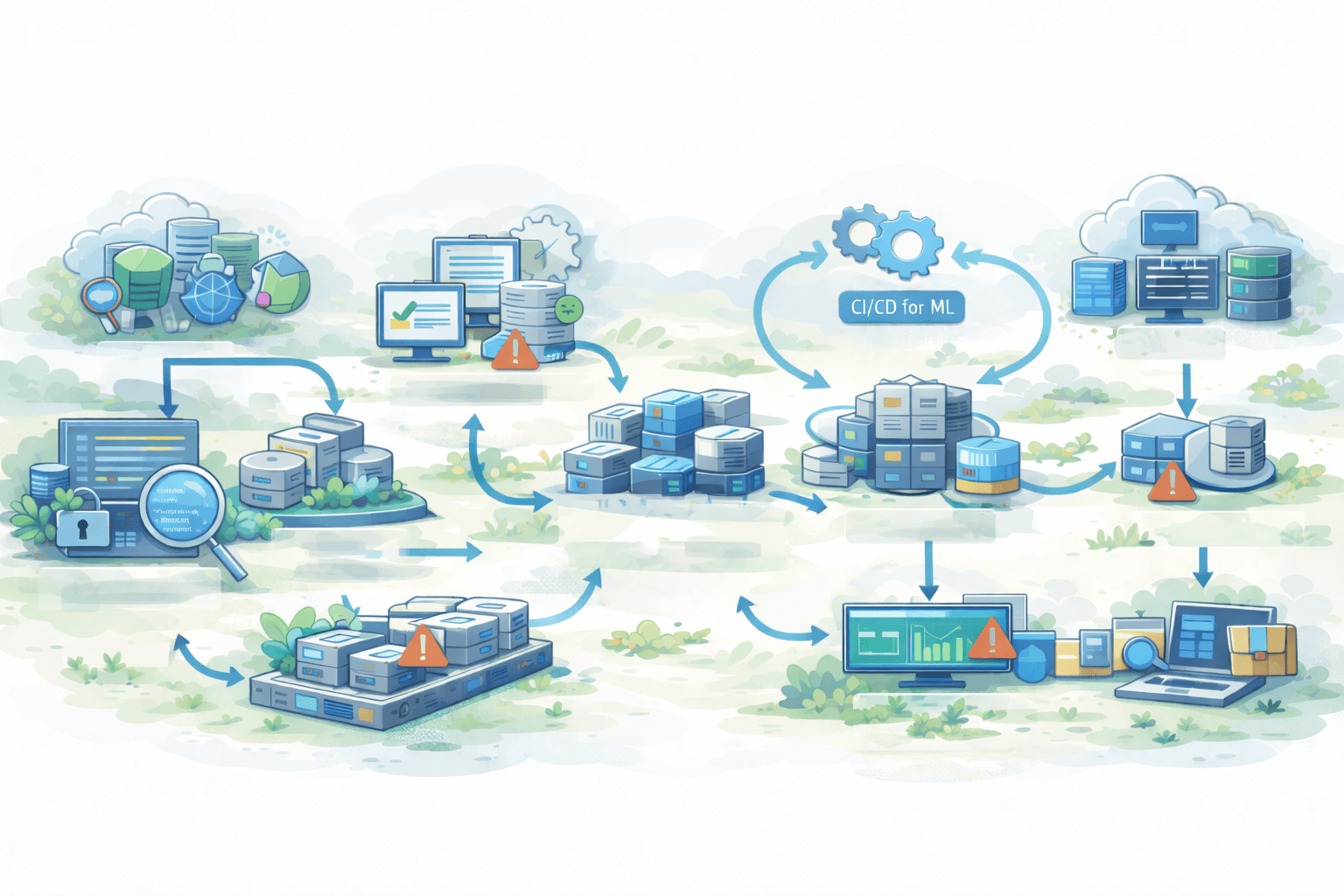
- A good MLOps architecture diagram helps you see the full loop: data → features → training → registry → serving → monitoring → retraining.
- The pipeline requires treatment as a product which should include gates that prevent both poor data entries and incorrect model applications and dangerous deployment methods.
- Pick a MLOps reference architecture pattern which suits your organization by selecting between cloud-native and Kubernetes-first and hybrid options.
- The implementation of ownership systems and governance structures and multi-team operational management should take precedence over acquiring additional tools when working at large scales.
- The system requires a maturity roadmap which starts with MVP development followed by registry implementation and then CI/CD deployment and drift checks and governance structure.
Teams experience three common failure points which include their inability to duplicate models and their practice of making silent-breaking changes and their failure to detect drift until business performance deteriorates. Those are not “data science problems.” They are architecture problems. Google’s guidance on MLOps automation calls out the need for CI/CD and continuous training, plus automated data and model validation in production pipelines.
This MLOps architecture guide gives you two diagrams, reference options, a scalable pattern, and a practical checklist. If you want a second set of eyes on your current setup, MLOps consulting services can help you map gaps fast.
What you will get:
- A platform-level view (end-to-end)
- A pipeline view (train → deploy → monitor → retrain)
- Three implementation patterns
- A scale-up checklist (must-have vs nice-to-have)
- A maturity roadmap from MVP to enterprise
MLOps Architecture Diagram: End-to-End Platform View
Use this MLOps architecture diagram to understand “how the pieces talk.” Read it left to right, then follow the feedback loop back from monitoring to retraining.
How to read the flow: data → features → training → registry → serving → monitoring → retraining.
[Data sources]
|
v
[Ingestion] —> [Data validation & quality checks]
| |
v v
[Raw/curated storage] (stop / alert / quarantine)
|
v
[Feature store] (optional) —> [Feature definitions + versions]
|
v
[Training orchestration] —> [Experiment tracking + metadata]
| |
v v
[Model artifact + metrics] ———-> [Model registry]
|
v
[CI/CD for ML]
|
+———————-+——————+
| |
v v
[Serving: online API] [Serving: batch]
| |
v v
[Monitoring: data + model + system] <—-> [Alerts + dashboards]
|
v
[Retraining triggers]
(schedule / drift / business events / human request)
Governance layer across everything:
access control • lineage • approvals • audit logs
Core building blocks (platform components)
These are the platform components most teams end up needing, no matter which tools they pick. Think of them as the “minimum set of blocks” that let you build, ship, and operate models without guesswork or hero debugging.
1. Data sources + ingestion
Your current resources include product events and CRM data and IoT streams and partner feeds and manual labels which you can start using immediately. The system needs to generate versioned inputs which should remain consistent throughout time even though you will start by saving only one daily snapshot. This is the first weak point in machine learning platform architecture: if ingestion changes silently, every downstream metric becomes suspect.
2. Data validation & quality checks
Add automatic checks before training and before serving updates. Google’s reference describes automated data validation to detect schema and value skews, and to stop the pipeline when inputs don’t match expectations.
Practical checks to start with:
- Schema checks (missing columns, type changes)
- Range checks (impossible values, outliers)
- Freshness checks (data arrived on time)
- Label health checks (class balance, missing labels)
3. Feature store (optional but common)
A feature store provides benefits when different models access identical features and when you want to maintain equal performance between model training on data and model deployment in production. Do not treat it as mandatory on day one. Add it when “feature inconsistency” becomes a repeat incident.
4. Training orchestration
Orchestration runs training reliably: scheduled retrains, triggered runs, resource isolation, and retry rules. A good MLOps pipeline architecture makes training runs reproducible and easy to audit.
5. Experiment tracking + metadata
Tracking answers: what data, what code, what parameters, what results, and who approved it. Without this, you cannot debug regressions or explain changes to stakeholders.
6. Model registry
A registry stores approved model versions with metadata, lineage pointers, evaluation results, and deployment status. Azure’s MLOps v2 pattern explicitly separates inner-loop model development from outer-loop deployment, with a registry step that promotes models through CI pipelines.
7. CI/CD for ML
Treat models like a release artifact. CI should validate code, data contracts, and evaluation. CD should handle safe promotion, rollback, and checks for environment drift. If you already run strong DevOps, DevOps solutions often cover the shared foundation (repos, CI, IaC, observability).
8. Serving (online/batch)
Online serving supports low-latency predictions. Batch supports scheduled scoring (nightly churn lists, demand forecasts). Keep the serving contract stable: inputs, outputs, latency budget, and fallback behavior.
9. Monitoring (data + model + system)
Monitoring needs three layers:
- System: latency, error rates, saturation
- Data: schema shifts, distribution drift, missing values
- Model: performance metrics, calibration, segment health
10. Governance (access, lineage, approvals)
Governance becomes non-negotiable when multiple teams ship models, or when compliance matters. This is where the MLOps top architect earns their keep: they define who can do what, which approvals exist, and how you track lineage end to end.
If you want tooling options by component, AppRecode’s MLOps tools list can help you map tools to blocks.
MLOps Pipeline Architecture Diagram: Train → Deploy → Monitor → Retrain
The platform view shows components. This MLOps pipeline architecture diagram shows the control loop.
1) Train
– pull versioned data/features
– run training + evaluation
– log metrics + artifacts
|
v
2) Validate (gates)
– data checks
– eval thresholds
– bias/segment checks (if needed)
|
v
3) Register + Package
– publish model version
– bundle dependencies
– create deployment candidate
|
v
4) Deploy
– canary or shadow
– monitor impact
– promote or rollback
|
v
5) Monitor
– system signals
– data drift signals
– model quality signals
|
v
6) Retrain / Re-approve
– trigger new run
– repeat gates
This MLOps pipeline architecture works because it forces “stop points.” Google’s automation guidance stresses that production pipelines need automated data validation and model validation before promotion.
Quality gates (what stops bad models)
A production ML pipeline needs stop points, not just automation.
Data checks
- Block training when schema breaks, when freshness fails, or when label health collapses.
Evaluation thresholds
- Compare candidate vs baseline (or current production model).
- Use minimum thresholds per key segment, not only one global score.
Human approval (optional)
- Add approval when model impact is high, or regulation requires it.
- Keep it lightweight: approve only when gates fail, or when drift crosses a limit.
Canary / shadow deployment
- Shadow runs predictions without affecting decisions.
- Canary serves a small percent of traffic, then ramps up.
Rollback rules
- Roll back when latency, error rates, or business proxy metrics degrade.
- Automate rollback where you can, but keep a “manual override” path.
If you need a MLOps pipeline architecture image for docs or onboarding, you can copy the diagram above into a wiki, and keep it versioned with your platform repo.
MLOps Reference Architecture: Three Common Implementation Patterns
There is no single “best” MLOps reference architecture. The right pattern depends on constraints like cloud strategy, data residency, platform maturity, and how much control your team needs over runtime, networking, and security.
1) Cloud-native reference (AWS/Azure/GCP)
This MLOps reference architecture reduces platform work, but it can increase vendor lock-in. Azure’s MLOps v2 guide organizes the lifecycle into modular phases (data estate, setup, inner loop, and outer loop), and it stresses repeatable, maintainable patterns.
Typical fit:
- Small-to-mid teams moving fast
- Clear cloud standard (one provider)
- Preference for managed operations
2) Kubernetes-first platform
Kubernetes-first setups run training, serving, and workflows on K8s. This pattern fits teams that already run Kubernetes at scale, and want one runtime for ML and non-ML services. It also fits custom needs (GPU scheduling, sidecars, service mesh). If Kubernetes is your base, Kubernetes consulting services can help with cluster design, security, and workload reliability.
Typical fit:
- Strong platform team
- Multi-tenant clusters
- Need for portability
3) Hybrid architecture (common in enterprise)
Hybrid mixes on-prem data, private networks, and cloud compute. It is common when data can’t move freely, or when orgs already run big data platforms internally. Design the seams carefully: identity, network, data movement, and audit trails.
Typical fit:
- Strict data residency
- Legacy systems, and multiple environments
- Heavy compliance needs
Pick the MLOps reference architecture that matches constraints first, then choose tools. Many teams do the reverse, and pay for it later.
Scalable MLOps Architecture: What Changes at Scale
A scalable MLOps architecture changes less in boxes and more in process: ownership, guardrails, and the ability to run many models safely at once.
At scale, you will see:
- Many teams shipping models (not one central group)
- More environments (dev, test, staging, prod, plus region splits)
- More audits (who approved what, and why)
- More drift cases (data sources change weekly)
Must-Have vs Nice-to-Have Components
Must-Have Components
- Versioned data snapshots or dataset references
- Repeatable training pipeline (not notebook-only)
- Experiment tracking + metadata
- Model registry with promotion rules
- CI checks for code, configs, and evaluation gates
- Serving with canary/shadow support
- Monitoring for system + data + model signals
- Incident playbooks (what to do when drift hits)
This is the core of a scalable MLOps architecture because it prevents silent failure.
Nice-to-Have Components
- Feature store (when reuse and parity become hard)
- Automated bias checks (when risk profile demands it)
- Automated retraining triggers with human review
- Multi-armed bandits or advanced rollout strategies
- Online training or streaming feature pipelines
- Central governance portal (when audits grow)
If you need a MLOps pipeline architecture image for exec decks, keep it simple: show the loop, and show the gates. People approve what they can understand.
Expert View (what the key resources say)
The resources show actual platform views of MLOps architecture through their documented implementation methods. The five articles present different perspectives through their content which includes automation and lifecycle structure and maturity development and design principles and operational compromise requirements.
- Google Cloud Architecture Center (2024): The system operates through CI/CD processes and ML continuous training which uses modular pipeline elements that contain containerized steps for reproducibility and automated data/model validation to prevent bad runs from occurring.
Link: MLOps: Continuous delivery and automation pipelines in machine learning | Cloud Architecture Center - Microsoft Learn (Azure MLOps v2, 2024): The system enables deployable patterns which establish separate development paths for models and deployment functions through its inner and outer loops to display both system development phases and user categories.
Link: Machine learning operations - AWS video (AWS Summit ANZ 2022): The piece displays architecture diagrams which progress from small to large size while demonstrating MLOps as a sequential process which incorporates registries and automation and monitoring and retraining at different stages.
Link: End-to-End MLOps Architecture Design Guide – AWS - Medium (architecture principles, 2024): Argues for classic software engineering principles, including “least surprise,” and warns against unusual architecture choices that confuse operators. Use it as a sanity check when your design feels “clever.”
Link: Some Architecture & Design Principles for MLOps and LLMOps - MinIO blog (2025): Compares homegrown setups vs formal tooling, and highlights common platform needs like versioning datasets and tracking models across experiments.
Link: MLOps Architecture Guide for AI Infrastructure
These documents serve as reference materials which you should use instead of copying their content word for word. The team needs to modify the common principles of reproducibility and validation and monitored deployments and clear ownership based on their organizational structure and work constraints.
Maturity Roadmap: MVP → Growth → Enterprise
MLOps architecture changes as the number of models, teams, and risks grow. This roadmap helps you sequence work so you can ship something safe early, then add control, governance, and multi-team operations when you actually need them.
MVP (ship safely in weeks)
Goal: minimal pipeline + basic serving + basic monitoring.
- One training pipeline
- One deployment path (batch or online)
- Simple model registry (even if basic)
- System monitoring, plus a small drift signal
- A short runbook (“what do we do when metrics drop?”)
A good place to anchor MVP decisions is AppRecode’s MLOps lifecycle best practices.
Growth (add control and repeatability)
Goal: registry + CI/CD + drift monitoring + release process.
- Promotion rules and approvals
- Canary or shadow deployments
- Data and model validation gates
- Drift alerts tied to tickets and owners
- Reproducible environments (container images, pinned dependencies)
This is where a second MLOps architecture diagram helps onboard new teams fast.
Enterprise (3–6+ months)
Goal: governance, lineage, multi-team ops, security controls, auditability.
- Central lineage and audit logs
- Strong access control (least privilege)
- Standard templates per use case (tabular, CV, NLP)
- Multi-region considerations and disaster recovery
- Security reviews, and compliance reporting
At this stage, you are building machine learning platform architecture for the whole org, not just one model.
If you want help designing and implementing this end to end:
You can also review AppRecode on Clutch.
For examples of what teams usually build first (and what to skip), see MLOps use cases.
Common Architecture Mistakes (and quick fixes)
The majority of MLOps failures result from several common errors which include absent version control and exclusive use of notebooks and insufficient security checkpoints and limited monitoring that only tracks system availability. The fixes below are quick, and they remove common causes of regressions and “mystery drift.”
Mistake 1: No versioned data inputs.
Fix: snapshot datasets, or store references with immutable IDs.
Mistake 2: Notebook-only training
Fix: move training into a pipeline job with tracked inputs and outputs.
Mistake 3: No gates in the pipeline
Fix: add the minimal gates from the MLOps pipeline architecture diagram: data checks, evaluation thresholds, and safe rollout.
Mistake 4: Serving differs from training
Fix: reuse the same feature transformations, and test parity.
Mistake 5: Monitoring stops at uptime
Fix: monitor model quality and data drift, not only CPU and latency.
Mistake 6: One team owns everything forever
Fix: define clear ownership and templates so other teams can ship safely. Your MLOps architect should build guardrails, not become a bottleneck.
The MLOps architect needs to create protective systems which safeguard advancement instead of creating obstacles to block development.
Final Thoughts
A good MLOps architecture system which follows proper design principles executes two main operations which consist of automated model deployment and immediate system breakdown identification. The first day needs all necessary elements but you should create both a step-by-step process sequence and particular checkpoints which show how to move forward.
The platform diagram helps organizations achieve team alignment but the pipeline diagram serves as the main tool for protecting their production systems. If you keep one living document, make it this MLOps architecture guide, and update it when you change ownership, data sources, or release rules.
If your team asks for an MLOps pipeline architecture image, give them the loop plus the gates, and skip tool logos. Tools change. Workflows stay.
FAQ
What’s the minimum MLOps architecture needed to ship a model safely?
A minimum setup needs a reproducible path from an identified dataset and code revision to a versioned model artifact. Put training code, feature transformations, dependency definitions, and pipeline configuration under version control. Record the data snapshot or immutable data reference, parameters, evaluation results, and environment used for each candidate. Without that chain, a team cannot explain or rebuild what it deployed.
The pipeline should stop on failed data and model checks. At a practical minimum, validate the input schema and required fields, test transformation code, evaluate the candidate on held-out data, and compare its results with an approved baseline. Add checks for important segments rather than relying only on one average score. Package the inference code with the model and test the prediction contract before promotion.
Production deployment may begin with a human approval, but it should still be controlled and repeatable. Register the approved artifact, deploy it through the same scripted path each time, keep the previous version available, and define a rollback trigger. Monitor service health—errors, latency, saturation, and traffic—alongside data quality and whatever model-quality signal can be measured after deployment.
This is enough for one model if ownership is explicit. Name the people responsible for data failures, pipeline failures, model degradation, and the serving service. A feature store, Kubernetes platform, or automated retraining loop can wait. Reproducibility, validation, controlled release, monitoring, and rollback cannot.
When should we add a feature store to the MLOps platform?
Add a feature store when feature management has become a shared operational problem, not simply because it appears in an architecture diagram. Useful signals include several models reimplementing the same features, teams struggling to discover which definitions already exist, or online inference requiring fresh feature values at low latency. A store can provide managed definitions, metadata, access controls, and reuse across training and serving.
The online/offline distinction matters. Historical, point-in-time data is needed to construct training sets without leaking future information. Online serving usually needs the latest approved values with predictable latency. A feature-store design may offer both paths, but the team must still define event time, ingestion, freshness, backfills, ownership, and how online and offline values remain consistent. Buying the component does not fix an incorrect transformation.
Do not add one merely to centralize a handful of batch features used by a single model. A versioned transformation pipeline and a governed table can be simpler and cheaper. First measure the actual pain: duplicated computation, training-serving skew, slow online lookups, missing lineage, or access-control sprawl. Then pilot the store against that problem.
Before adoption, estimate the new operational load as well. Feature stores introduce schemas, ingestion jobs, retention rules, permissions, monitoring, and another production dependency. The right time is when the reduction in duplicated work and inconsistency is worth that continuing cost.
How do we prevent training-serving skew in our pipeline architecture?
Make training and inference use the same transformation definition wherever possible. The strongest pattern is to implement a feature once, package or register that implementation, and call it from both the training pipeline and the serving path. When identical execution is impossible—for example, batch SQL during training and a streaming implementation online—treat the two versions as a contract and test them against the same input fixtures.
Record event time and build point-in-time-correct training data. A training job must not use information that would have been unavailable when a historical prediction was made. At serving time, monitor feature freshness and handle missing or late values explicitly rather than silently substituting a different calculation. An online/offline feature-store setup can help, but only if ingestion, backfills, and transformation ownership are well designed.
Add parity checks before deployment. Run a representative sample through the training transformation and the inference implementation, compare types and values within documented tolerances, and fail the release when they differ. Validate the model’s input signature too: names, order, shape, units, categorical mappings, and default behavior.
Production monitoring closes the loop. Compare incoming schemas and distributions with the approved baseline, alert on missing-feature rates and freshness, and retain enough lineage to connect an anomaly to a pipeline or feature version. Skew is rarely solved by one tool. It is controlled through shared definitions, point-in-time data, contract tests, and observable production inputs.
Which monitoring signals matter most for scalable MLOps architecture?
Monitor the system in layers because no single metric explains whether an ML product is healthy. Begin with the serving service: request rate, latency percentiles, errors, timeouts, resource saturation, queue depth, and batch completion. Track deployment versions and route every alert to an owner with a runbook. These signals reveal whether predictions are available, but not whether they are useful.
Next watch the data. Validate schema, types, allowed ranges, missing values, category changes, feature freshness, and distribution shifts. Segment the checks where the business or risk profile differs; an overall distribution can look stable while one region or customer group changes sharply. Log enough identifiers and versions to trace a bad input back to its ingestion and transformation path without exposing sensitive data unnecessarily.
Model monitoring depends on when ground truth arrives. When labels are available, measure the approved quality metrics over time and by important segment. Also follow calibration or ranking quality where those properties matter. Without timely labels, use input drift, prediction distributions, confidence patterns, rule-based outcomes, and human review as imperfect early warnings. Drift is a reason to investigate, not automatic proof that retraining will help.
Finally, connect signals to actions. Define thresholds for alerting, traffic reduction, rollback, investigation, and retraining. Track business outcomes and costs beside technical metrics. A scalable architecture is one in which monitoring produces an owned decision, rather than thousands of charts that nobody is expected to act on.
How do we choose between a cloud reference architecture and Kubernetes-first MLOps?
Start with an awkward operational question: when the ML platform fails on Sunday, who is expected to repair it? A managed cloud service is attractive when the team would rather spend its time on data, evaluation, and the product than on building registries and serving infrastructure. It is especially practical when the data, identities, networks, and audit controls already sit with that provider. Check the bill and the exit path, though. Managed APIs, quotas, regional availability, and storage or network charges become part of the architecture.
Kubernetes changes the ownership answer. It is a reasonable foundation when the company already runs reliable clusters and wants similar deployment mechanics on premises and in more than one cloud. The team gains choices around scheduling, networking, isolation, and platform components. It also inherits the pager for cluster upgrades, autoscaling, secrets, storage, and every ML service installed above Kubernetes. A cluster supplies orchestration; it does not magically supply experiment history, model approval, feature management, or risk controls.
Hybrid designs often look portable until data starts moving. Trace one real model through identity, network boundaries, training data, artifact promotion, encryption keys, logs, and production support in each location. Note where the paths differ and who owns each handoff.
Finally, prototype that complete path rather than comparing idealized diagrams. Include availability targets, team experience, regulation, data gravity, likely scale, and several years of operating cost. Choose the platform your organization can recover and upgrade with confidence.
What should be versioned to make an ML system reproducible?
Version more than the trained model file. A reproducible run needs the training and inference code, feature-transformation logic, pipeline definition, dependency or container specification, parameters, and infrastructure configuration. Link those items to the exact data snapshot or an immutable query and partition reference. If the source is mutable, capture enough lineage to reconstruct the input as it existed at training time.
Record the outputs of the run as metadata: evaluation metrics, segment-level results, model signature, training environment, random seeds where relevant, and the identity of the pipeline that produced the artifact. Register the model with a unique version and approval state rather than copying a file to an ambiguously named production folder. Dataset and feature definitions need owners and change history too.
Reproducibility does not always mean bit-for-bit equality. Hardware, parallel execution, nondeterministic algorithms, and external services can introduce variation. Define the level the use case requires: identical artifact, statistically equivalent metrics, or results within an accepted tolerance. Test restoration periodically instead of assuming stored metadata is sufficient.
The deployed record should connect the serving endpoint to a model version, code revision, configuration, and input contract. That link supports incident response and rollback. It also answers the questions auditors and engineers eventually ask: what is running, who approved it, what data produced it, and can the team rebuild or retire it safely?
How should an MLOps pipeline deploy and roll back a model safely?
Promote an immutable model package through environments instead of rebuilding it for production. Before release, verify its signature and dependencies, test the serving contract, scan the image and packages, and compare model results with the approved baseline. Keep the decision gate explicit: automated thresholds may approve a low-risk change, while sensitive use cases can require a named reviewer.
Avoid sending all traffic to a new model immediately. A shadow deployment can observe predictions without affecting users. Canary or blue/green patterns expose a small, controlled share of traffic and make comparison or reversal easier. A/B testing serves a different purpose: measuring the effect of alternatives on an outcome. Whichever strategy is chosen, define assignment rules and success metrics before looking at results.
Rollback must cover more than the model artifact. Preserve the previous model, inference image, feature contract, configuration, and routing rule. If a new model depends on a changed schema or feature pipeline, confirm that the old version can still receive valid inputs. Test the rollback path during a planned exercise; an untested button is not a recovery plan.
Set triggers for service errors, latency, model-quality regression, harmful segment behavior, or a business guardrail. Some failures justify immediate automated rollback, while ambiguous drift should open an investigation. Log the promotion, approver, traffic changes, metrics, and final decision. Safe delivery is a controlled experiment with a rehearsed exit, not merely a successful deployment command.
Where do security and governance belong in an MLOps architecture?
Security and governance should appear on the arrows of the MLOps diagram, not as a final approval box. At intake, write down why the model exists, who owns it, who will use its output, and what harm would make the project unacceptable. That context determines which data may be used and how much review a release needs. The data engineer, researcher, deployment pipeline, and auditor rarely need the same permissions, so one broad “ML team” role is a poor default.
Follow an artifact through the pipeline. Can the team identify its data sources and usage restrictions? Are transformation and evaluation records attached? Were packages and serving images checked, and can production verify that the promoted artifact is the approved one? Pipeline identities should have narrow permissions; secrets do not belong in notebooks or job logs. Development and production can be separated where the risk calls for it, with sensitive data encrypted on the way and at rest.
Turn policy into gates that produce evidence. Depending on the use case, a candidate may need schema checks, a minimum quality result, segment review, vulnerability scanning, privacy sign-off, or a named approver. A registry entry should tell an unfamiliar engineer what the model is, where it came from, and whether it may be deployed.
The work continues in production. Give someone authority to pause, roll back, and eventually retire the model. Review access changes, incidents, complaints, drift, and real-world outcomes on a schedule. The NIST AI RMF’s Govern, Map, Measure, and Manage functions are useful headings; the platform still needs named owners and working controls beneath them.