
TL;DR
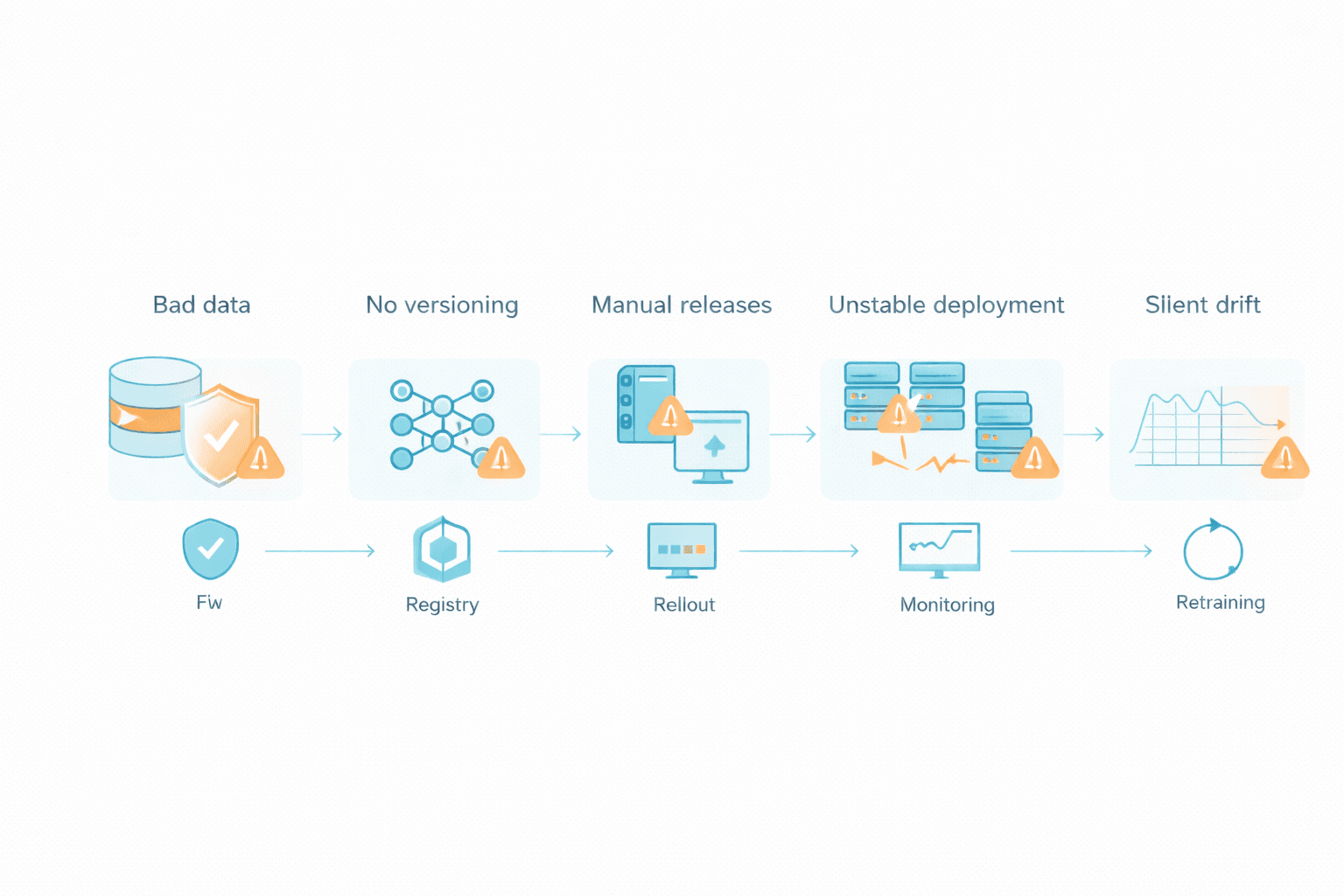
- Most teams see common MLOps challenges as slow releases, recurring bugs, and models that fail in production.
- Data quality and data ownership drive outcomes more than model code does.
- Versioning ends guesswork because the team can trace data, code, parameters, and artifacts.
- Automation lowers risk, because gates block bad inputs and weak candidates before deployment.
- Deployment safety needs contracts, controlled rollouts, and rollback triggers.
- Drift monitoring stops silent failure, which is one of the worst challenges of MLOps.
- Fix order matters more than buying tools.
Production ML fails in predictable ways. Pipelines drift, data changes, and releases turn into late-night events. Teams often call these MLOps challenges, but the root cause usually sits in delivery basics: missing gates, missing ownership, and missing feedback loops.
This guide lists five failure modes and fixes you can apply in order. For quick definitions, see the Wikipedia page on MLOps. For related disciplines, compare AIOps vs MLOps and DataOps vs MLOps.
The 5 Biggest Challenges in MLOps
Challenge #1. Data Problems → Bad Predictions
What It Looks Like
- Accuracy drops in one region, segment, or channel, while the headline metric stays stable.
- Features arrive late, go missing, or shift in meaning.
- Labels change definition, so training no longer matches production reality.
Why It Happens
Data pipelines change more often than teams track. A join drops rows, an event field changes type, or a source system updates logic. Then the model keeps predicting from a new reality. Red Hat also notes that scaling from a single model to many increases inconsistency across pipelines and teams. See Red Hat’s summary of scaling challenges.
How To Fix It
- Add data contracts: schema, allowed ranges, and freshness checks.
- Validate before training and before serving updates.
- Assign owners for sources, labels, and feature definitions.
- When data foundations need a reset, data engineering services can help align data quality with ML delivery.
Challenge #2. No Versioning → No Trust
What It Looks Like
- Nobody can reproduce last month’s run, even with the “same” notebook.
- Debugging turns into debates, not evidence.
- Rollbacks fail because the previous artifact cannot be rebuilt.
Why It Happens
Teams version code, but they skip data versions, configs, and environments. Then each run becomes a snowflake. Google’s guidance stresses repeatable steps, validation, and controlled promotion in production pipelines. See Google Cloud’s MLOps automation guidance.
How To Fix It
- Store dataset snapshots, or immutable dataset references.
- Track code commit, parameters, and container image for every run.
- Log artifacts and metrics under one run ID.
- Add a registry step, so “approved” has one source of truth.
Challenge #3. No Automation → Slow, Risky Releases
What It Looks Like
- One person “babysits” releases and patches failures by hand.
- Teams ship late, because everyone expects problems.
- Checks live in spreadsheets, or teams skip them to hit deadlines.
Why It Happens
Pipelines lack gates. Teams treat each release as a special event, not a repeatable process. These are typical MLOps implementation challenges, because ML delivery cannot scale without standard controls.
How To Fix It
- Start with three gates: data validation, baseline comparison, and smoke tests.
- Add promotion rules: dev → staging → production only after thresholds pass.
- Use CI for tests, dependency checks, and config validation.
- Get help with delivery design through CI/CD consulting.
- For stack selection, use the MLOps tools list.
Challenge #4. Deployment Issues → Downtime & Latency
What It Looks Like
- Latency spikes under load, even when tests pass.
- Model updates break clients because the input or output contract changes.
- Training-serving skew appears, and results drift after release.
Why It Happens
Teams ship a model artifact, but they do not ship a stable service contract. Runtime differences also bite: libraries, hardware, and feature transforms differ between training and serving. That is one of the most repeated challenges in MLOps, because it mixes app delivery and model behavior.
How To Fix It
- Define an inference contract: inputs, outputs, latency budget, and fallback behavior.
- Use shadow or canary rollouts before full promotion.
- Load test the service, and add clear rollback triggers.
- For architecture patterns that reduce skew and downtime, read MLOps architecture.
Challenge #5. No Drift Monitoring → Silent Model Failure
What It Looks Like
- Business metrics slip, and the team notices weeks later.
- Uptime looks healthy, but prediction quality decays.
- One segment fails badly, but averages hide it.
Why It Happens
Monitoring stops at system signals. Teams do not track input drift, feature health, or model quality proxies. This turns a small change into a slow leak.
How To Fix It
- Monitor three layers: system, data, and model.
- Track drift signals: schema change, distribution shift, and missing values.
- Track model signals: calibration, segment health, and business proxies.
- Tie alerts to owners and runbooks, then review drift weekly.
- For practical patterns, see MLOps best practices and examples in MLOps use cases.
The “Fix First” Checklist (What To Implement in Order)
Use this sequence if the team needs stability fast. It targets MLOps challenges that cause the most production pain.
| Order | Implement First | Goal | Why It Comes First |
|---|---|---|---|
| 1 | Data validation gates | Stop bad inputs early | Most incidents start with data changes |
| 2 | Versioned runs (data, code, env) | Reproduce and audit | Removes guesswork during debugging |
| 3 | Registry + promotion rules | Control what ships | Prevents latest model surprises |
| 4 | Safe rollout (shadow/canary) | Reduce blast radius | Limits impact when issues appear |
| 5 | Drift monitoring + alerts | Catch silent failure | Protects business metrics |
| 6 | Retraining workflow + owners | Close the loop | Prevents stale models and unclear duty |
When You Need Help
Some challenges in MLOps resolve with disciplined fixes. Others repeat because the team lacks platform capacity or clear ownership, especially when several teams ship models. An audit finds missing stop points, unclear owners, and unsafe rollback paths across environments.
How AppRecode Solves These MLOps Challenges
AppRecode helps teams turn ad hoc delivery into a repeatable system: gates, registries, safe rollouts, monitoring, and clear ownership.
Common starting points include:
- Platform build via MLOps development services.
- Gap mapping via MLOps consulting services.
- Delivery foundations through DevOps solutions.
You can review delivery feedback on Clutch.
“Teams hit the same MLOps implementation challenges when they skip gates and ownership. Versioning and drift monitoring feel boring, but boring is what production needs.” – Nazar Zastavnyy, COO at AppRecode.

If the team wants to fix the top challenges of MLOps without guesswork, start with MLOps consulting services, then move into MLOps development services.
Start HereFinal Thoughts
The fastest path out of firefighting is boring, consistent work: contracts, gates, versioning, rollouts, and monitoring. Once those exist, common MLOps challenges stop repeating, and delivery becomes predictable.
For extra field examples, this Medium post lists pitfalls teams often miss: Hidden MLOps pitfalls.
FAQ
What Are the Most Common MLOps Challenges?
The most frequent issues include data quality breaks, missing versioning, manual releases, unstable deployments, and missing drift monitoring. Teams reduce these issues by adding gates, registries, safe rollouts, and monitoring tied to owners.
What Are the Biggest MLOps Implementation Challenges?
The biggest delivery blockers are reproducibility, ownership, and cross-team release control. These are the core challenges in MLOps because tools cannot replace standards, gates, and duty assignment.
How Do You Detect Data Drift and Model Drift?
Detect data drift by tracking schema changes, distribution shifts, missing values, and feature freshness for production inputs. Detect model drift by tracking segment health, calibration, and business proxy metrics, then tying alerts to owners and runbooks.
What Is the Minimum MLOps Setup for Production?
A minimum setup includes versioned inputs, reproducible training, basic validation gates, a controlled deployment path, and monitoring for both system health and drift. Google’s guidance on automated validation and promotion provides a solid baseline.
How Do You Make ML Deployments Safer?
Use shadow or canary rollouts, stable inference contracts, and automatic rollback triggers. Combine those with CI checks and promotion rules, so only verified models reach production.