
Healthcare drives a major technological shift, and connected devices play a vital role in monitoring patients, as well as handling other medical workflows. In particular, connected sensors can be used to track the state of medical equipment and manage resources in the hospital. With such innovations, healthcare practitioners can create an entire ecosystem. Such an ecosystem of connected devices is what comprises the Internet of Things for healthcare.
In this article, we will explore common use cases for IoT devices in healthcare and some of the key aspects in more detail.
What Is IoT in Healthcare?
Healthcare IoT is a term used to describe a network of connected medical devices, sensors, software platforms, and cloud services that exchange health-related data in real-time.
Depending on their purpose, such systems can differ. Some of them are designed for monitoring patients and their key health indicators. Other examples of IoT technology in healthcare are designed to monitor medical equipment or even the conditions in a hospital.
Typically, an IoT healthcare network includes:
- wearable monitors
- connected diagnostic tools
- smart implants
- asset-tracking devices
- hospital room sensors
- cloud analytics platforms
Their purpose is simple:
Collect real-time data → turn it into insights → support faster and better decisions in the healthcare setting.
Main Healthcare IoT Benefits
The use of the Internet of Things in the medical domain brings many advantages to different parties involved.
If you are a healthcare provider, such technology helps you:
- Improve clinical decisions by supporting you with real-time data
- Automate processes by reducing manual paperwork and routine tasks
- Establish continuous remote monitoring, which allows you to lower hospital readmissions
- Track the state and the location of hospital equipment with greater accuracy.
If you are a patient, you can benefit from IoT devices used in healthcare in the following ways:
- You will receive timely treatment adjustments thanks to continuous monitoring
- Healthcare practitioners will get more information on your individual health patterns, which will allow them to provide more personalized care
- You will spend less time in the hospital because of IoT systems’ at-home monitoring capabilities
- Your health will be tracked, monitored, and controlled constantly, which is especially relevant to chronic-condition patients.
Top IoT Applications in Healthcare
The Internet of Things is already widely applied across various areas in healthcare. Some of the most notable applications for such technologies in the medical sector include:
Remote monitoring of patients

Smart hospital infrastructure
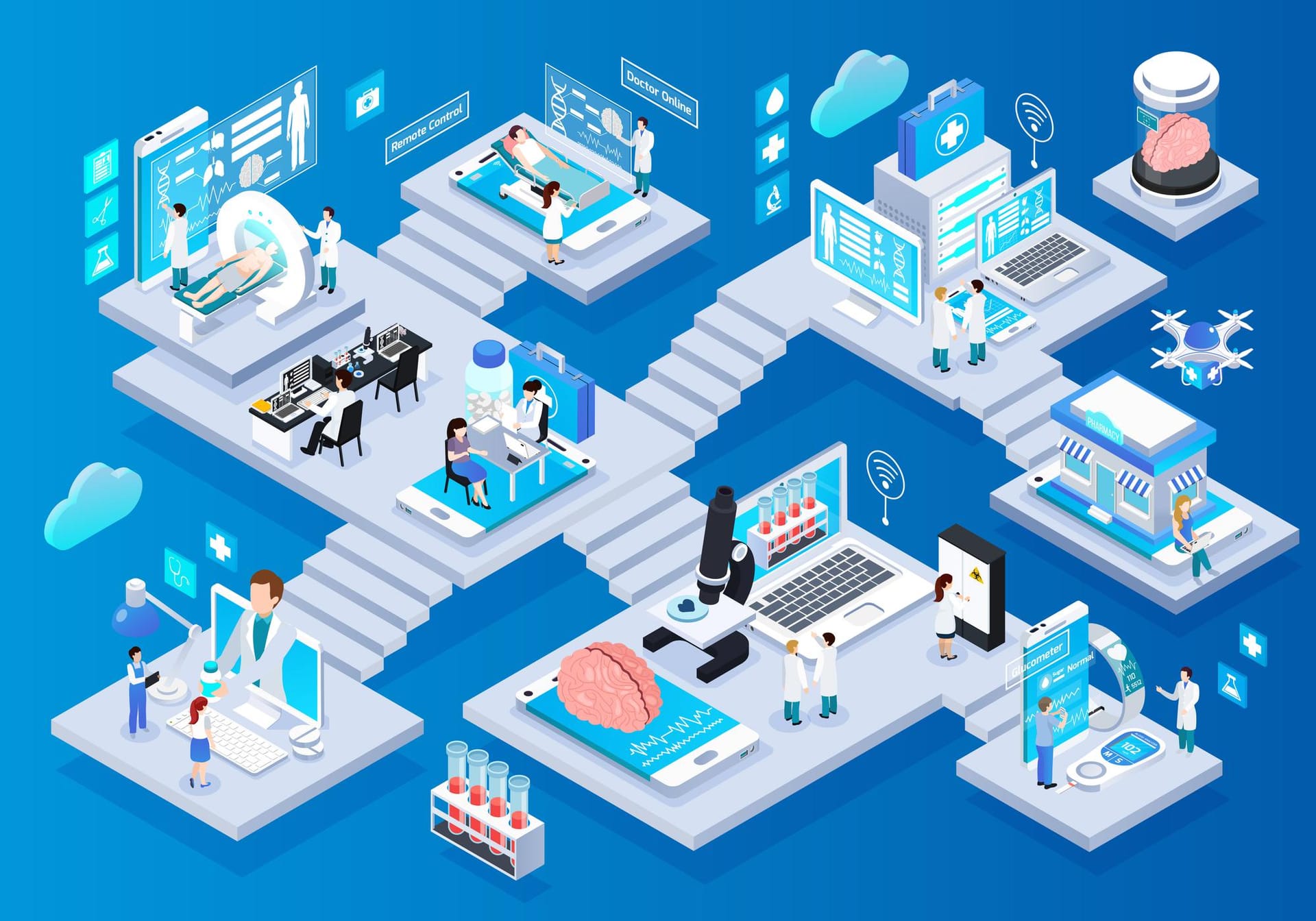
Smart medical devices, such as connected insulin pumps

Predictive maintenance of medical equipment
Medication adherence systems, such as smart pill dispensers

Let's proceed with more specific applications of the Internet of Things in healthcare applications. Here are some notable examples:
- Smart EGG devices are used to send patient data directly to cardiologists, which is vital for real-time cardiac monitoring
- IoT systems track the conditions in the hospital, providing insights into air quality, humidity
- Smart infusion systems automatically pump medications, such as insulin, into the patient’s blood
- Wearables that help doctors monitor patient recovery after surgery
- IoT trackers that help healthcare professionals track hospital equipment and its state
Examples and Real-World Use Cases of IoT in Healthcare
Let’s explore some notable real-world cases where medical institutions and companies have successfully applied IoT technologies.
Mercy Health System
Mercy Health System runs a virtual hospital in Missouri. This healthcare company applies IoT devices for patient monitoring, providing excellent care at home.
BIO-sensors
Philips cooperates with Cassia Networks to deploy its BIO-sensors (BX100) in hospital wards. This collaboration allows hospitals to ensure continuous monitoring of patients’ vital signs.
Medtronic
Medtronic, a global medical technology company, provides connected insulin pens and implantable cardiac devices to establish an extensive network for preventing heart failure.
Best Practices from Experts
Rolling out IoT in healthcare works best when you don’t try to conquer everything at once. Most teams start with a tiny pilot — something you can actually measure — and only expand when it proves itself. These are some other practices that can make a difference:
- We strongly recommend you focus on common standards like MQTT, HL7, or FHIR to ensure device interoperability.
- Run regular device audits.
- Focus on building fortified security since day one.
- Nurses, doctors, techs — the folks who use these systems every day — should be involved early. If the tools don’t match the way they work, the whole idea falls apart.
“IoT in medicine helps you treat patients remotely and improve the quality of medical services. If you are ready to handle connectivity and security issues, you will understand the benefits almost immediately.”
Volodymyr Shynkar, Co-Founder at AppRecode
Challenges and Security Concerns
While the use of IoT devices in the medical domain brings many promises, it is also associated with some notable concerns. These are the most common problems associated with IoT in medical field:
- Issues with unauthorized access to patient devices
- Industry compliance requirements, such as those pertaining to HIPAA cloud computing
- Device interoperability issues
- High infrastructure costs
- Problems with managing a large fleet of devices and all software packages updated
How to Implement IoT in Healthcare Systems
A structured implementation process helps avoid risks and ensures long-term results:
- Access your networks, devices, and workflows to gain a clear vision of your current infrastructure
- Create user scenarios and assess preferred use cases
- Select the most fitting devices, cloud platform, and software for your project
- Integrate your Internet of Things in healthcare solutions with EMR/EHR platforms using HL7 or FHIR
- Establish security practices
- Train your clinical staff to work with IoT solutions in the most efficient way

Need Expert Guidance for Your Healthcare IoT Project?
Build secure, scalable, and compliant IoT systems with a team that understands healthcare workflows, data sensitivity, and real-world integration challenges.
Start HereWhy Choose AppRecode for IoT Healthcare Projects
AppRecode supports healthcare organizations through every stage of IoT adoption. We pay specific attention to IoT in DevOps, which is crucial to us keeping your system updated and efficient in the long run. You may find more information about us and our experience in our Clutch profile.
These are some of the key benefits of cooperation with our team:
- Strong experience with the best DevOps in healthcare practices.
- Experience with IoT solutions, as well as their management and configuration
- Rich experience with device integration
- Rich portfolio of successful projects in the medical domain
Final Thoughts
There is a great range of applications of IoT in healthcare. While properly combined, they help medical practitioners bring excellent remote care and continuous supervision of patients. However, if you want to follow the examples of the most successful IoT in healthcare projects, you need to follow some of the best industry practices. Help from an experienced technology team will also be crucial.
FAQ
What are the most common IoT devices used in healthcare?
Such a list includes:
- Wearable monitors
- ECG patches
- Smart pumps
- Asses trackers
- Environmental sensors
How secure is IoT in the medical field?
There are specific safety practices pertaining to IoT use cases in healthcare. These include:
- Proper encryption
- Authentication
- Monitoring
- Log tracking
- Regular security auditing
What are the benefits of IoT applications in hospitals?
IoT applications in healthcare help practitioners:
- Improve patient monitoring
- Enhance workflows
- Use resources more efficiently
- Keep equipment in better condition
How can IoT improve patient monitoring?
Such solutions collect patient conditions continuously and alert practitioners once significant changes occur.
What challenges exist in implementing IoT for healthcare?
Even the best examples of IoT in healthcare may face issues with:
- Security
- Interoperability
- Regulatory compliance
- Integration with legacy systems