
TL;DR
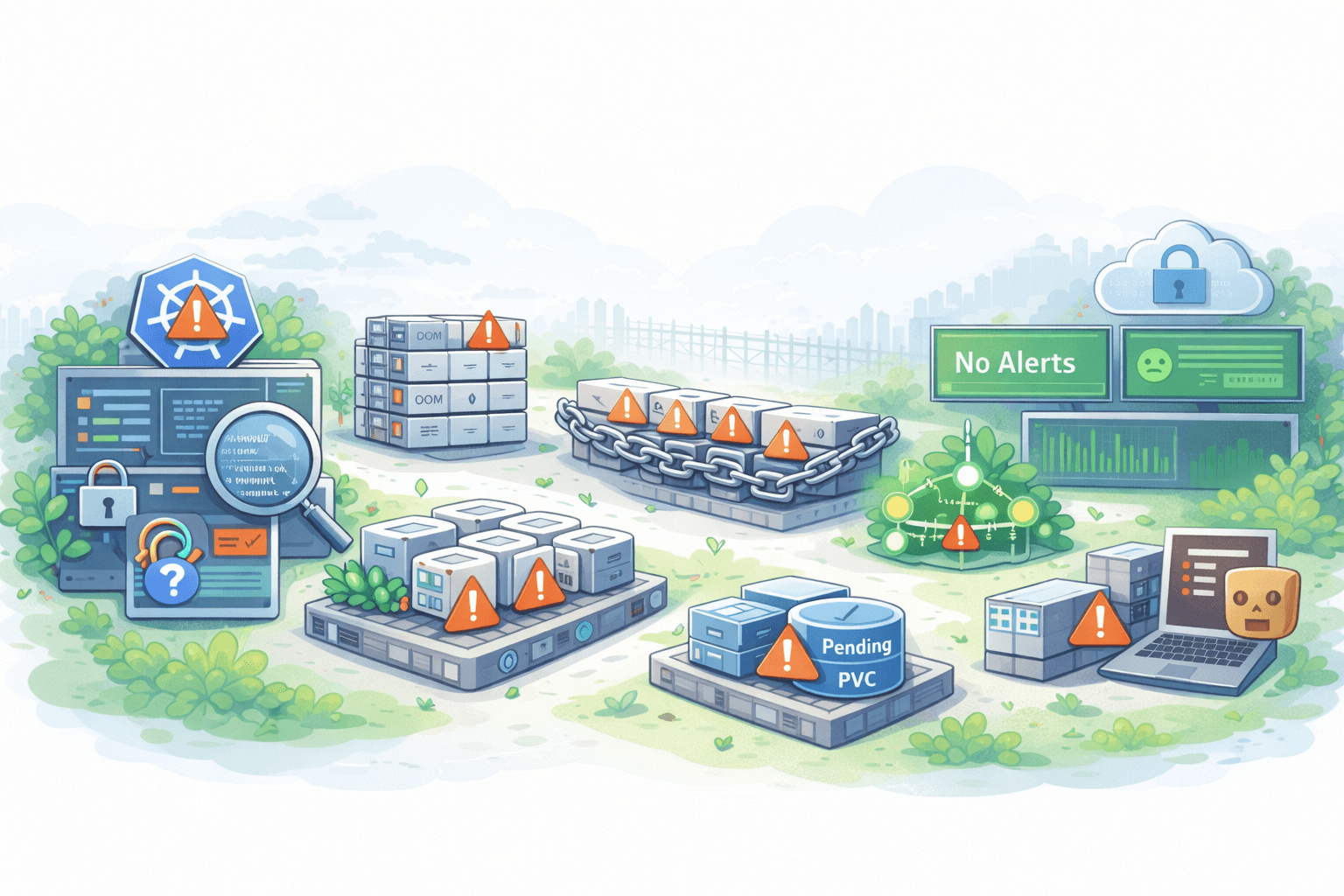
- Most outages start with small config gaps, not “bad Kubernetes.”
- RBAC mistakes can turn one compromised pod into a cluster-level incident.
- Missing requests and limits often leads to noisy neighbors, OOMKilled pods, and node pressure.
- Bad probes cause restart loops, broken rollouts, and “it works on my laptop” debugging.
- NetworkPolicy errors either block real traffic or allow far too much lateral movement.
- No alerts means you find incidents from customer tickets, not dashboards.
- Drift and YAML sprawl quietly break environments over time.
- Storage configs fail in the worst moment: deploy day, scale day, or node replacement day.
The primary cause of incidents results from incorrect system configurations which impact all Kubernetes organizations regardless of their team members’ Kubernetes expertise. The platform will follow your exact configuration so you can execute your code but it will still result in system downtime. Only the right partner at your side and the right checklist can be a remedy.
According to the 2025 Komodor Enterprise Report, 79% of Kubernetes production outages were linked to configuration and change issues, showing how often setup errors, not core platform flaws, trigger real downtime.
In this article, you will see 10 frequent outage triggers. One Kubernetes misconfiguration can knock out a service, break rollouts, or block traffic in ways that look like “random instability,” until you trace it back to configuration.
Each issue follows the same pattern: Symptom → Fix → Prevent. Use it as a checklist for reviews, incident postmortems, and pre-prod gates.
Core Section: 10 Misconfigurations
1. RBAC over-permissions
Symptom
- A compromised app account can list secrets, edit deployments, or create pods.
- Incidents spread across namespaces faster than expected.
Fix
- Audit service accounts used by workloads. Remove cluster-admin and broad * verbs.
- Prefer Role/RoleBinding inside a namespace. Use ClusterRole only when truly needed.
- Rotate credentials if you suspect abuse.
Prevent
- Define least-privilege roles per app.
- Add policy checks that block risky verbs like create on pods/exec and secrets reads unless justified.
- Treat “default” service accounts as unsafe; set automountServiceAccountToken: false where possible.
This sits among the most damaging common Kubernetes security misconfigurations because it turns a small breach into a big outage.
2. Missing CPU and memory requests and limits
Symptom
- Pods get OOMKilled, nodes show memory pressure, and rescheduling storms start.
- One workload “steals” resources, and others slow down or crash.
Fix
- Add requests for every container. Start with real measurements (p95 usage), not guesses.
- Add limits carefully. For memory, limits help; for CPU, limits can throttle under load.
Prevent
- Enforce “no requests/limits = fail” in CI.
- Track resource usage per workload, and review it monthly.
- Use namespaces with ResourceQuota to stop one team from consuming the entire cluster.
3. Misconfigured readiness and liveness probes
Symptom
- Pods restart in loops, deployments never become ready, or traffic goes to half-warmed instances.
- Rolling updates stall, and autoscaling behaves oddly.
Fix
- Separate readiness from liveness: readiness checks “can serve,” liveness checks “is wedged.”
- Increase initialDelaySeconds for slow startups. Add startupProbe for apps that need warm-up.
- Make probe endpoints cheap and reliable (no DB migrations, no heavy queries).
Prevent
- Test probes under slow dependencies and cold starts.
- Add a canary rollout step so one bad probe does not take the whole fleet down.
- Document probe standards per runtime (Java, Node, Go, Python).
4. NetworkPolicy mistakes
Symptom
- Service-to-service calls time out after a “small security change.”
- DNS breaks, metrics scraping fails, or ingress can’t reach backends.
Fix
- Start by confirming baseline connectivity: DNS, kube-apiserver access (if needed), ingress paths, and egress to required endpoints.
- If you use default-deny, add explicit allows for DNS (CoreDNS), monitoring, and ingress-controller namespaces.
- Verify policy selectors (labels, namespaces). One wrong label can block everything.
Prevent
- Keep policies in Git, and test them with connectivity smoke tests in staging.
- Label conventions matter. Standardize them, and validate labels in CI.
- Treat these as Kubernetes security misconfigurations with uptime impact, not only “security settings.”
5. No monitoring and alerting
Symptom
- You learn about failures from users.
- Teams lose hours guessing: “is it the app or the cluster?”
Fix
- Add basic signals: API server health, node status, pod restarts, error rates, latency, and saturation.
- Alert on symptoms that matter: crash loops, high 5xx, failing probes, pending pods, and node pressure.
Prevent
- Ship a baseline monitoring pack with every cluster.
- Run a periodic DevOps health check to spot gaps before incidents become outages.
6. Poor namespace isolation
Symptom
- “Dev” changes affect “prod,” or one team breaks another team’s workloads.
- Shared secrets, shared service accounts, and shared quotas create chaos.
Fix
- Separate environments by namespace at minimum, and by cluster when risk is high.
- Use ResourceQuota, LimitRange, NetworkPolicies, and scoped RBAC per namespace.
Prevent
- Define “golden” namespace templates.
- Standardize labels, quotas, and policies per environment.
- Many misconfigurations in Kubernetes start here because teams treat namespaces as folders, not boundaries.
7. Misused autoscaling
Symptom
- Sudden scale spikes, runaway costs, or zero scaling when load increases.
- HPA flaps because metrics lag, or targets are wrong.
Fix
- Confirm metrics source (Metrics Server, Prometheus adapter).
- Tune HPA: sane min/max replicas, target utilization, and stabilization windows.
- Ensure requests exist; HPA needs them for CPU-based scaling.
Prevent
- Load-test autoscaling in staging with production-like traffic.
- Add alerts for “HPA at max for N minutes” and “no scale events during high load.”
- Document when to use HPA vs. KEDA vs. scheduled scaling.
8. Configuration drift and YAML chaos
Symptom
- “Same app, different behavior” across clusters or namespaces.
- Hotfixes in prod never return to Git, and future deploys reintroduce old bugs.
Fix
- Move changes back into version control immediately.
- Adopt a single deployment path (Helm, Kustomize, or GitOps), and stop manual kubectl apply in prod.
Prevent
- Require PR-based changes, code owners, and environment promotion rules.
- Add policy-as-code to reject risky defaults.
- This is one of the most common misconfigurations in Kubernetes, and it gets worse as the cluster grows.
9. Storage misconfiguration
Symptom
- Stateful pods stay Pending, PVCs never bind, or pods fail after node replacement.
- You see attach/mount errors, wrong access modes, or “volume already in use.”
Fix
- Check StorageClass, provisioner health, and default class settings.
- Validate PVC size, access mode (RWO/ROX/RWX), and zone/region constraints.
- Confirm backup and restore paths before you need them.
Prevent
- Standardize StorageClasses, and document when to use each.
- Run a game day: delete a node and confirm stateful recovery.
- Monitor volume latency and provision failures.
10. Missing container security policies
Symptom
- Containers run as root, privilege escalation slips in, or images run with unsafe defaults.
- Security reviews block releases late because the cluster lacks guardrails.
Fix
- Enforce Pod Security Admission (or equivalent controls) with a clear baseline.
- Block privileged pods unless explicitly approved.
- Require non-root, read-only root filesystem where possible, and drop dangerous Linux capabilities.
Prevent
- Treat policy gaps as security misconfigurations in Kubernetes because attackers also love “oops, we forgot.”
- Use the Kubernetes Top 10 guidance from the OWASP Foundation as a checklist for cluster component hardening.
These are also common Kubernetes security misconfigurations because teams focus on shipping, and skip guardrails until an incident forces the issue.
Outage Triage Map (2-minute diagnosis)
| Symptom | Most likely misconfig | Check first |
|---|---|---|
| OOMKilled | requests/limits | Pod spec requests/limits, node memory pressure, recent deploy |
| Pods restarting | probes | Readiness/liveness events, probe endpoints, startup time |
| Timeouts between services | NetworkPolicies | Default-deny rules, DNS allow, namespace selectors |
| Sudden scale spikes | HPA | Metrics source, target utilization, min/max stabilization |
| Stateful pods pending | storageClass/PVC | StorageClass default, PVC events, CSI controller logs |
| Cross-env weirdness | namespaces + drift | Namespace isolation, manual changes, Git vs. live diff |

If outages keep coming back, treat it as a process problem, not a one-time fix. Start with an audit, then lock the basics behind gates. For hands-on help, check our Kubernetes consulting services.
Start HereCommon Kubernetes Misconfigurations Prevention Playbook (what to enforce in CI/CD)
Use gates that block outage-risk configs before they hit prod:
- YAML lint + schema validation
- Policy-as-code (OPA Gatekeeper, Kyverno, or similar)
- RBAC checks (deny wildcard permissions, flag cluster-admin bindings)
- “No requests/limits = fail” for workloads
- Image scanning, pinned tags, and SBOM generation
- Connectivity smoke tests after deploy (DNS, service calls, ingress routes)
- Baseline monitoring pack (dashboards + alerts) shipped with every cluster
- A review loop for drift detection (GitOps diff, config audit reports)
If you want help setting up these gates fast, CI/CD consulting fits well for teams that need a clean delivery path without surprise rollbacks.
Expert View
The developers lose sight of fundamental platform verification because their team delivers new features at a rapid rate. Most recurring Kubernetes incidents stem from basic security controls which were either omitted or established with insufficient restrictions.
RBAC scope and health probes and resource budgets become necessary only when systems operate at their highest capacity or when new deployments take place because these elements fail to function at that time. That reality frames the point below. As CEO and Co-Founder of AppRecode Volodymyr Shynkar puts it:
“Moving faster without breaking things” starts with boring checks: RBAC scope, probes, and resource budgets.”
It’s not glamorous work, but it’s the kind that prevents repeat outages and late-night rollbacks. If you want a sense of how AppRecode approaches these basics in real projects, you can also see AppRecode reviews on Clutch.
Final Thoughts
Teams rarely fail because Kubernetes “breaks.” They fail because configs drift, defaults stay unchecked, and safety rails never become standard. The solution needs to address its most critical problems right away before organizations can start using CI gates and they should only keep basic runbooks for dealing with critical emergencies.
The best time to catch Kubernetes security misconfigurations happens before the cluster begins accepting network traffic. The second-best time is right after the last incident.
FAQ
How do we prioritize fixes when everything looks misconfigured?
Start with the issues that cause a broad blast radius: RBAC scope, requests/limits, probes, and NetworkPolicies. Then address drift, monitoring, and storage.
What are the fastest “pre-prod” checks to catch outage-risk configs?
Run policy checks (RBAC, Pod Security), validate requests/limits, run connectivity smoke tests, and verify probes under cold start. Add basic dashboards and alerts before launch.
Which misconfigurations are most likely to impact multi-tenant clusters?
Over-permissive RBAC, weak namespace isolation, missing quotas, and permissive NetworkPolicies cause the biggest cross-team impact. Many teams also underestimate security misconfigurations in Kubernetes in shared clusters.
How do we validate changes safely without risking a production rollback?
Use canary rollouts, staged promotions, and automated tests per deploy. Keep rollbacks ready, but aim to catch issues earlier with gates and staging load tests.
What should a minimal Kubernetes monitoring baseline include?
Node pressure alerts, pod restart and CrashLoopBackOff alerts, deploy health (ready replicas), latency and error rate for key services, ingress health, and storage provision/attach error alerts.